



Most hosts assume more bookings means more marketing budget. It doesn’t have to. Some of the highest-ROI moves for direct bookings cost nothing but time — and a few of them are sitting unclaimed in tools you already have access to. Here’s the order that actually works, starting with the free ones.
1. Claim and optimize your Google Business Profile
This is the single highest-leverage free tool available to any homestay host, and most haven’t touched it. When someone searches “homestay near [your location],” Google surfaces business listings and map results before organic search results even load. If you don’t have a verified Google Business Profile, only OTA listings show up in that space — meaning Airbnb or MakeMyTrip gets the click, and the commission, on a search that could have gone straight to you.
Setting it up:
- Create your profile under the correct category (“homestay” or “vacation home rental”)
- Fill in your description completely — you get roughly 750 characters, and it’s worth explicitly mentioning “direct booking” and “no service fees,” since fee-aware travelers actively search for that language
- Upload at least 15-20 real photos
- List your website link and phone number
- Keep your Name, Address, and Phone Number (NAP) consistent across every platform you’re listed on — inconsistency quietly hurts your local search ranking
A completed, well-maintained profile has been shown to earn significantly more clicks than an empty one — Google’s own research puts it at up to 7x more.
2. Get on Google’s Free Booking Links
Fewer hosts know about this one. Beyond the basic Business Profile, Google Hotels (the comparison module that shows up when someone searches for accommodation) has an organic, no-cost listing option called Free Booking Links — separate from paid Google Hotel Ads.
To qualify, you need a verified Google Business Profile plus a connectivity partner — your PMS, channel manager, or booking engine — that sends your live rates and availability to Google. If your booking system already supports this integration, turning it on costs nothing and puts your direct site in the same price-comparison view where guests are actively deciding between an OTA and booking with you directly. Worth checking whether your current booking engine or channel manager already supports this before assuming you need something new.
3. Turn past guests into repeat, direct bookings
Every guest who’s already stayed with you is a lower-friction booking than any new guest you’d have to find. The tools for this are ones most hosts already have:
- WhatsApp — a simple “we’d love to have you back” message ahead of a season they previously visited in costs nothing and converts far better than any ad
- A thank-you note after checkout with a personal touch, sometimes with a small returning-guest discount
- Timed seasonal messages — if you’re in a destination with a predictable peak season, a message a few weeks ahead of that window tends to fill calendars faster than any paid campaign
Consistency matters more than frequency here. A returning guest doesn’t need to hear from you every week — they need to hear from you at the right moment.
4. Treat reviews as a compounding, free marketing asset
Reviews aren’t just trust signals for guests — they directly affect your Google ranking too. Every satisfied guest you ask for a review (on Google specifically, not just your OTA listings) is compounding, permanent marketing that costs nothing beyond the ask itself. A simple, well-timed request — right after a guest’s positive feedback in person or over WhatsApp — converts far better than a generic post-checkout email blast.
5. Local partnerships — free cross-promotion
Partnering with nearby businesses costs nothing but a conversation, and it works both ways:
- A local café or tour operator can refer guests directly to you, and you can return the favor for your guests
- Offering a small perk (a discount, a welcome basket sourced locally) with a nearby business gives guests a reason to remember your property specifically, not just “a homestay in the area”
This is especially effective in destinations where a few local businesses already have strong guest trust — you’re borrowing some of that trust, at zero cost.
6. SEO content that answers what your future guests are actually searching
This is slower than the tactics above, but compounds over time and costs nothing but writing time. Guests searching “homestay near Manali Mall Road” or “family-friendly villa with private pool in Goa” are typing specific, location-and-feature phrases — not generic terms. A few blog posts or website pages built around those exact phrases, with real local detail, help you show up in searches an ad campaign would otherwise be needed to reach.
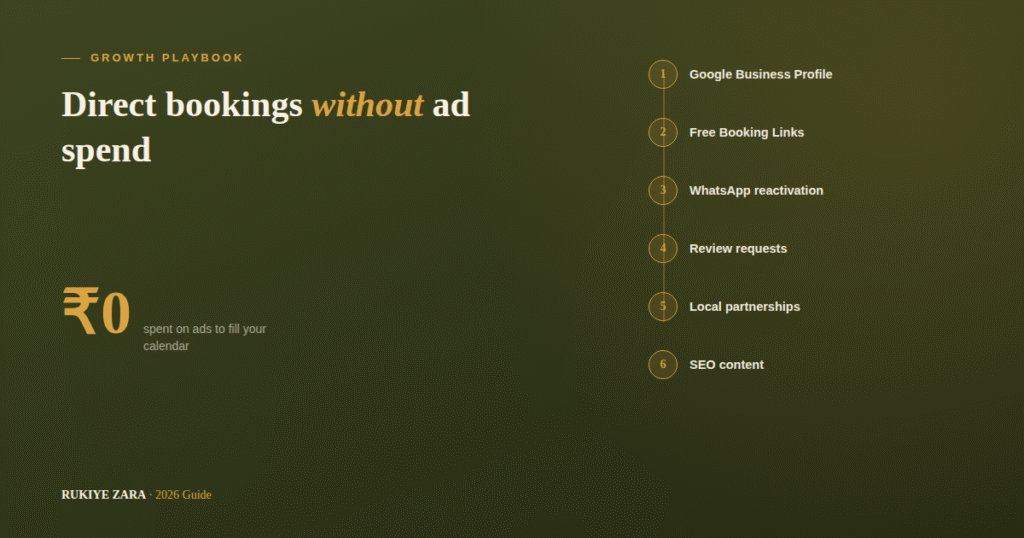
The order that actually works
If you’re starting from zero, the sequence that gets the best return for the least effort is:
- Google Business Profile — highest ROI, costs nothing, takes an afternoon
- Free Booking Links — a one-time setup check with your booking system
- WhatsApp reactivation of past guests — ongoing, minutes per message
- Review requests — built into your post-checkout routine
- Local partnerships — a handful of conversations
- SEO content — the slowest compounding return, worth starting early
Don’t reverse this order chasing the flashier tactics first — Google Business Profile and repeat-guest outreach alone often move the needle more than anything else on this list, and both are already free.
Frequently asked questions
Do I need a website before doing any of this? Google Business Profile and WhatsApp reactivation work even without one, though a simple booking page makes the eventual conversion smoother once someone finds you.
How long before Google Business Profile actually drives bookings? Verification alone can take about a week (Google mails a postcard with a code), and ranking improves gradually as reviews and consistent activity build up — this is a weeks-to-months timeline, not instant.
Is this realistic for a single-room homestay, or only larger properties? All of these tactics work at any size — in fact, a single-room host often has an easier time maintaining a fast, personal WhatsApp relationship with past guests than a larger property does.
Do I have to choose between OTAs and these organic tactics? No — none of this requires leaving Airbnb or any OTA. It’s about building a parallel channel that doesn’t hand over 15-20% of every booking, alongside the platforms you already use.
Rukiye Zara helps Indian boutique and homestay owners turn organic visibility — Google, WhatsApp, and repeat guests — into real direct bookings, without ad spend or added complexity.