



A guest books your homestay at 11pm. By the time they wake up, they should already have a confirmation, check-in directions, and a reason to feel good about the booking — without you touching your phone. That’s the actual bar for a WhatsApp booking system in 2026, and it’s a lot more specific than “reply to guests on WhatsApp instead of email.”
Here’s what it actually takes to get there, and how it works inside Rukiye Zara specifically.
Why WhatsApp, and why not just the free app
Regular WhatsApp — the app on your phone — works fine at very low volume: one property, one number, replying manually. The moment you want automation, more than one person handling messages, or a connection to your booking data, the free app runs out of road. It has no automated triggers, no way to sync with your booking calendar, and no way for a second team member to log in alongside you.
That’s the gap the WhatsApp Business API fills — and it’s what powers the automation layer inside Rukiye Zara, connected through AiSensy and MSG91 more coming soon. The distinction matters because it’s the difference between “a faster way to text guests” and “guest communication that runs itself.”
What actually triggers, and when
Here’s the specific sequence Rukiye Zara automates once a booking comes in — not a generic list of “things WhatsApp can do,” but the actual event-based flow:
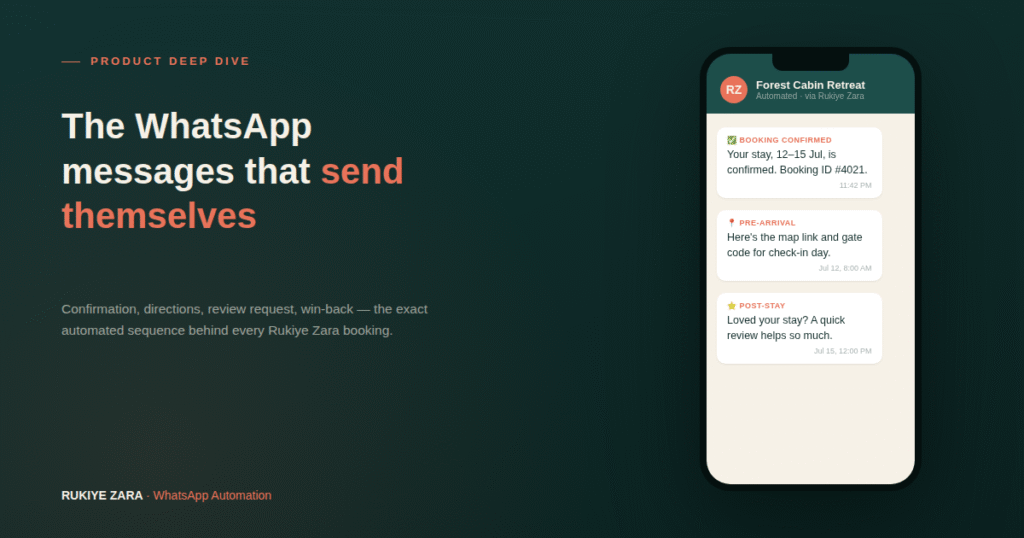
The moment a booking is confirmed — whether it came through your Rukiye Zara direct-booking site or synced in from a connected OTA — a confirmation message fires automatically to the guest’s WhatsApp. No one on your team has to remember to send it, and it goes out at 2am just as reliably as at 2pm.
Ahead of check-in, guests receive directions and arrival details — the kind of message that used to mean a guest calling you from outside your gate because they got lost. Sent automatically, timed to actual check-in date, it removes a recurring low-value interruption from your day.
After checkout, a review-reminder message goes out at the point guests are most likely to actually leave one — while the stay is still fresh, not weeks later when they’ve forgotten specifics.
For past guests, the same guest data that powered their booking and stay messages becomes the list for marketing campaigns — a seasonal nudge, a returning-guest offer, sent as a broadcast rather than a message you’d have to write out one guest at a time.
Why this matters more in India specifically than almost anywhere else
WhatsApp’s open rates sit in the 95-98% range, dramatically higher than email — and in India in particular, WhatsApp is often the primary communication channel guests already trust, not a secondary one. A guest is far more likely to actually see and act on a WhatsApp message than dig through an email confirmation buried in a promotions folder.
For hosts specifically, this closes a real gap: OTA-routed bookings (from MakeMyTrip, Booking.com, and similar platforms) sometimes mask a guest’s actual phone number until later in the booking process, meaning a host’s WhatsApp reach has historically been strongest for direct bookings — which is exactly the channel Rukiye Zara’s booking engine is built to grow.
Why the sync matters as much as the message
None of this works well as a standalone WhatsApp tool bolted onto a booking system as an afterthought — the automation is only as good as the data feeding it. Because Rukiye Zara’s WhatsApp automation is connected to the same system as your channel manager and booking engine, a booking made through any synced channel — your website or a connected OTA — triggers the same guest journey without you manually re-entering guest details into a separate messaging tool. That connection is what turns “WhatsApp for guest messages” into an actual system, rather than one more app to check.
What this replaces, in practical terms
For a host currently doing this manually, here’s what typically disappears:
- Manually messaging every guest a confirmation after checking your booking calendar
- Fielding “how do I get there?” calls from guests who are already en route
- Remembering to ask for a review days after checkout (when open rates and guest willingness both drop)
- Building a returning-guest campaign list by hand from old booking records
None of these are complicated tasks individually — but done manually across every single booking, they add up to hours of repetitive work a week, exactly the kind of load automation is built to remove.
Is this overkill for a 1-2 room homestay?
Not really — if anything, the return is faster to feel at small scale, because a solo host doing everything themselves benefits the most from removing repetitive manual messaging. The threshold where this stops being “nice to have” is usually the first time a guest calls you lost outside your property, or the first missed review because nobody remembered to ask in time.
Frequently asked questions
Do I need to buy a separate WhatsApp API tool alongside Rukiye Zara? No — the automation runs through Rukiye Zara’s existing AiSensy integration, tied to the same booking and guest data your channel manager and booking engine already use.
Will guests need to download anything to receive these messages? No — messages arrive in the guest’s existing WhatsApp, the app they already have and check constantly. That’s the entire point.
What happens with guests who book through an OTA that masks their phone number? Direct-booking guests get the fullest experience since their contact details are available immediately. OTA-routed guests may pick up WhatsApp automation slightly later in their journey, once contact details become available — which is one more practical reason a growing share of direct bookings pays off beyond just avoiding commission.
Can I customize what these messages say? Yes — the trigger points (confirmation, pre-arrival, post-stay, campaigns) are built in, and the message content itself is yours to shape for your property’s voice.
Rukiye Zara bundles booking engine, channel manager, and WhatsApp automation (via AiSensy) into one system — built by an Airbnb Superhost (1,500+ reviews) who automated exactly this guest journey for her own properties before building it for other Indian hosts.