


If you’re sitting on an extra room in Himachal Pradesh and wondering whether it’s worth the paperwork to turn it into a homestay — the process just got significantly easier, and there’s real money on the table for doing it properly.
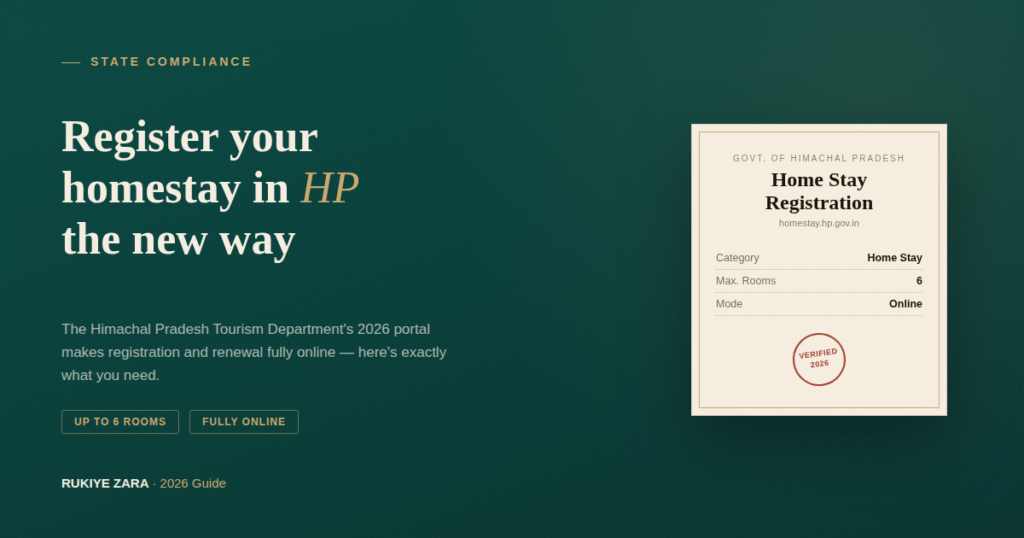
In February 2026, the Himachal Pradesh government launched a dedicated online portal — homestay.hp.gov.in — letting operators register and renew entirely from home, without visiting a government office. Here’s exactly what the process looks like now, what you’ll need, and what it’s worth doing right.
What changed in 2026
For years, homestay registration in Himachal Pradesh meant physical paperwork, in-person visits to the Tourism Department, and — for many owners — getting stuck waiting on a Fire NOC before renewal could go through.
That’s changed. Chief Minister Sukhvinder Singh Sukhu launched the new portal specifically to remove that friction, and made two decisions that matter directly to hosts:
- Fire NOC delays can no longer block renewal. The government directed the Tourism Department to issue provisional registration so homestays aren’t stuck waiting.
- The scheme now covers urban areas too, not just rural tourism zones — and homestays with up to six rooms can register, up from the older, narrower rural-only scope.
If you’d looked into this a year or two ago and found it too much hassle, it’s genuinely worth a second look now.
Who needs to register
If you’re renting out rooms to travelers in Himachal Pradesh — whether it’s one room in your own home or a small multi-room set-up — you fall under the Himachal Pradesh Home Stay Scheme, regulated by the state Tourism Department. This applies whether you list on Airbnb, OTAs, your own website, or a mix of all three. Registration isn’t tied to any one booking channel — it’s a state requirement for operating the business itself.
Documents you’ll need
Based on the Tourism Department’s registration checklist, have these ready before you start the online application:
- Ownership or lease proof for the property (or an affidavit if you’re a co-sharer)
- Property details: total area, number of rooms with individual sizes, attached bathrooms, dining/lounge space, parking availability
- Distance details: how far the property is from the nearest airport, railway station, city centre, and bus stand
- Photographs of the building exterior, each room, bathrooms, and common areas
- A blueprint or layout sketch of the homestay
- Police verification / local police station details for the applicant
- Fire safety details, if applicable (though this can no longer hold up renewal per the CM’s directive)
- Application fee payment — the portal supports UPI, net banking, and card payments alongside cash options
The registration process, step by step
- Get the property inspection-ready. Basic safety and hygiene standards apply: functioning fire safety equipment where required, clean and pest-free kitchen and common areas, comfortable bedding, and accessible parking where possible.
- Prepare your documents using the list above — most delays happen here, not during the actual application.
- Apply online at homestay.hp.gov.in with your property and owner details.
- Pay the application fee through the portal’s online payment options.
- Inspection. A local tourism officer visits to confirm the property matches what’s on the application.
- Registration certificate issued. Once approved, this certificate needs to be displayed prominently in the homestay and referenced in your online listings.
If your Fire NOC is still pending, remember: the state has directed that this alone should not block your registration or renewal — you’re entitled to provisional registration in the meantime.
Why it’s worth doing properly, beyond compliance
Registration isn’t just a legal checkbox. Himachal Pradesh currently offers an interest subsidy on tourism business loans — 3% in urban areas, 4% in rural areas, and 5% in tribal regions — for hosts setting up, expanding, or upgrading their property. That’s a meaningful incentive if you’re planning to add rooms or improve facilities, and it’s only accessible to registered operators.
There’s also a quieter, longer-term benefit: a registered, certified homestay is easier to market with confidence — to guests, to partners, and on your own booking channels — without worrying about a compliance gap catching up with you later.
Frequently asked questions
Do I need to register if I only host occasionally? Yes — if you’re accepting paying guests in Himachal Pradesh at all, you fall under the Home Stay Scheme regardless of how often you host.
Can I still register if my Fire NOC is delayed? Yes. The state government has directed that Fire NOC delays should not stop registration or renewal — provisional registration is meant to cover exactly this situation.
How many rooms can a homestay have under the current scheme? Up to six rooms, following the 2026 expansion of the scheme to include urban areas.
Do I need separate registration for each booking platform (Airbnb, OTAs, my own site)? No — the state registration covers your operation as a business, independent of which booking channels you use.
Where do I actually apply? Directly at homestay.hp.gov.in, the Tourism Department’s dedicated portal launched in February 2026.
Getting your registered homestay booking-ready
Once you’re registered, the next real question is how guests actually find and book you — especially if you want a channel that doesn’t hand 15-20% of every booking to an OTA. That’s a separate conversation from registration, but it’s the natural next step for any Himachal Pradesh host getting set up properly in 2026.
Rukiye Zara is a booking and management platform built by an Airbnb Superhost (1,500+ reviews) for Indian boutique and homestay owners, including hosts across Himachal Pradesh.