



If you run a boutique homestay in India, you already know the feeling: a booking notification pops up, you’re happy for a second — and then you see the payout after commission. It’s less than you expected. Again.
Most hosts never actually sit down and add up what OTAs take from them across a full year. When you do the math, it’s usually a lot more than it feels like booking-by-booking. Here’s the real breakdown.
What OTAs actually charge
Commission structures vary by platform, property type, and how much “visibility boost” a host opts into, but here’s the general range Indian homestay owners are working with in 2026:
- Booking.com: roughly 15–17% standard, climbing to 20–25% on preferred/boosted placements
- MakeMyTrip / Goibibo: roughly 15–25% for most properties, higher for standalone homestays chasing visibility
- Airbnb: commission structures vary by host fee model and can run lower than the above, though total guest-side fees are still built into pricing
- Agoda / Expedia: typically 18–22%
Across the board, most independent hosts are settling somewhere in the 15–20% range per booking — and that’s before you count what doesn’t show up as a line-item.
The worked example
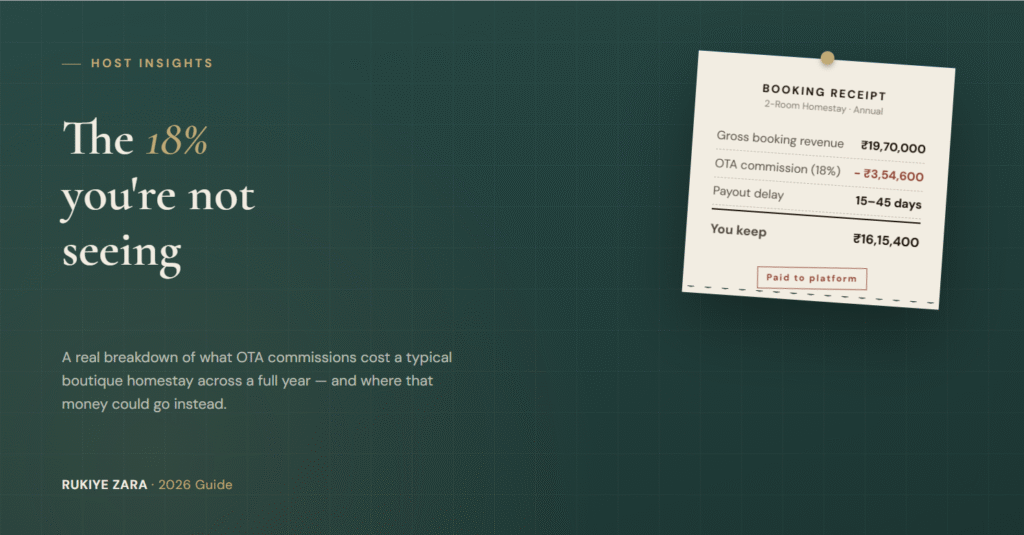
Let’s take a fairly typical boutique homestay: 2 rooms, average nightly rate of ₹4,500, running at 60% occupancy across the year.
- Room-nights sold per year: roughly 2 rooms × 365 nights × 60% ≈ 438 room-nights
- Gross revenue at ₹4,500/night: ≈ ₹19.7 lakh/year
- At an 18% blended OTA commission: ≈ ₹3.5 lakh/year goes straight to platforms
That’s ₹3.5 lakh — enough to cover a full-time housekeeping hire, a year of property upgrades, or simply sit in your account instead of a platform’s.
And that number only accounts for the visible commission line. It doesn’t include:
Payout delays. Most OTAs settle 15–45 days after guest checkout. You’re paying staff, electricity, and supplies upfront while your own revenue sits in someone else’s account.
Rate parity clauses. Many OTA contracts prevent you from listing a lower price on your own website than what’s shown on the platform — even for guests who found you organically. You’re locked into the commission cycle by contract, not just by convenience.
Visibility-boost creep. To stay competitive in search results, hosts increasingly pay 3–5% more to move up in rankings — meaning the “standard” commission on paper is often not what’s actually charged.
Why this compounds
None of this is a one-time cost. It’s a recurring tax on every single booking, every month, indefinitely — unless a growing share of your bookings comes direct.
Here’s the part hosts often miss: you don’t need to leave OTAs to fix this. You need a second channel that doesn’t charge per-booking commission — your own website, WhatsApp, and repeat-guest relationships doing more of the work over time.
What “direct” actually looks like for a homestay
A guest who stayed with you last year, loved it, and messaged you directly on WhatsApp to rebook — that’s a booking with zero commission. A guest who found your own booking website through Google and paid you directly — same thing.
The hosts who reduce their OTA dependence over time aren’t doing anything exotic. They’re doing three things consistently:
- Owning a booking page that isn’t buried inside someone else’s platform
- Capturing guest contact details at every stage — inquiry, booking, checkout — so repeat guests have a direct line back to you
- Making rebooking effortless, usually over WhatsApp, without asking guests to hunt you down on an OTA again
None of this happens by accident. It happens when a host builds the infrastructure for it — deliberately, once — and then lets it work quietly in the background on every booking after that.
The bottom line
OTAs aren’t the enemy — they’re a real, valuable discovery channel, especially for new properties. But treating them as your only channel means paying 15–20% forever on revenue that, over time, could increasingly be yours.
Run the numbers on your own property. If ₹3–4 lakh a year sounds directionally right — or even conservative — that’s the size of the opportunity sitting in front of you.
Rukiye Zara is a booking and management platform built by an Airbnb Superhost (1,500+ reviews) for Indian boutique and homestay owners — designed to help hosts build a real direct-booking channel alongside their existing OTA presence.