



Kerala doesn’t just “register” homestays — it classifies them. That distinction trips up a lot of first-time hosts, because the process, the fees, and even the certificate you end up with depend on which tier you’re applying for. Here’s exactly how it works in 2026.
Registration vs. classification — the difference that matters
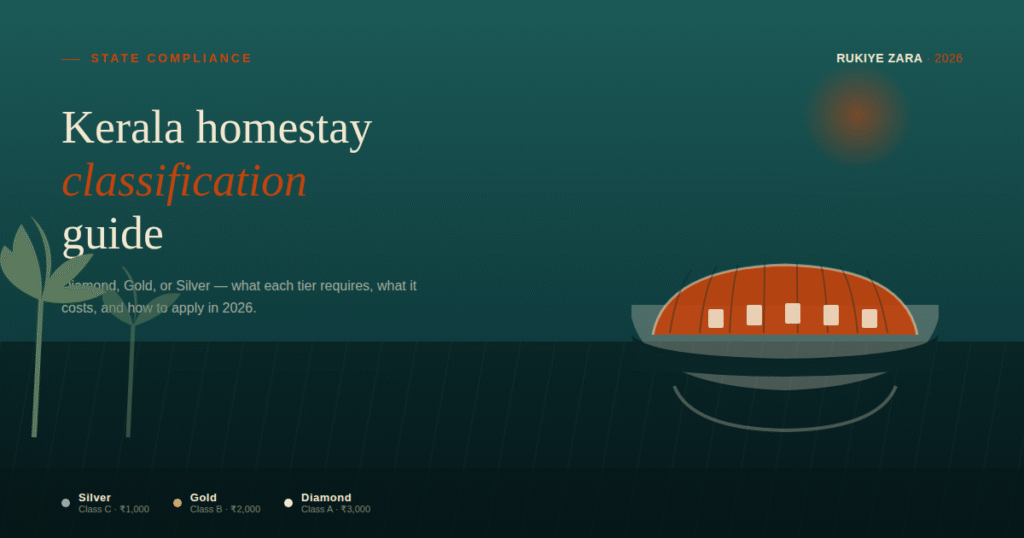
In most states, homestay registration is a single yes/no process. In Kerala, the Department of Tourism runs a classification scheme: every homestay is evaluated and placed into one of three tiers — Diamond (Class A), Gold (Class B), or Silver (Class C) — based on facilities, architecture, and service standards.
This matters for two reasons. First, your application fee depends on the category you’re applying for. Second, your classification becomes part of your credibility with guests — it’s a government-issued quality signal, not just a compliance formality.
Who’s eligible
Kerala’s homestay scheme has a stricter eligibility bar than some other states:
- You must be a resident of Kerala, applying for your own house — leased or rented properties are not eligible for classification.
- You can offer a minimum of 1 room (2 beds) up to a maximum of 6 rooms (12 beds).
- The owner or a family member must physically reside in the unit — this isn’t optional, and the Department checks for it during inspection.
If you’re planning to run a fully independent, unhosted rental property in Kerala, this particular scheme isn’t the right fit — it’s built specifically for owner-occupied, family-run homestays.
Documents you’ll need
Based on the current application requirements, have these ready:
- Residence-cum-ownership certificate from your local body (panchayat/municipality/corporation)
- Location and possession certificate from the village office
- Police clearance from your local Station House Officer
- Food Safety registration (FSSAI) — mandatory if you’re serving meals
- Property details: room count, room sizes, distance from airport/railway/bus stand/city centre
- Photographs of rooms, bathrooms, common areas, and the property exterior
- Application fee, paid via demand draft to the Director, Department of Tourism
One helpful update: as of a 2022 government order, a No Objection Certificate from your Panchayat, Municipality, or Corporation is no longer required for classification — a step that used to slow this process down considerably.
Application fees by category
Fees are modest and tied to the tier you’re applying for:
| Category | Class | Application Fee |
|---|---|---|
| Diamond House | Class A | ₹3,000 |
| Gold House | Class B | ₹2,000 |
| Silver House | Class C | ₹1,000 |
Fees are paid to the Director, Department of Tourism, Government of Kerala, and are non-refundable even if your application is rejected or you’re classified into a lower tier than applied for — so it’s worth being realistic about which category your property genuinely fits before applying.
The process, step by step
- Get your paperwork together — the certificates above take the longest, especially the residence-cum-ownership and village office documents. Start here first.
- Collect the application form from your District Tourism Promotion Council (DTPC) office, the Tourism Directorate, or apply online through the Department’s portal.
- Choose your category — Diamond, Gold, or Silver — based on your facilities honestly, since the fee is non-refundable regardless of outcome.
- Submit the application with your documents and fee to the District Officer, Department of Tourism.
- Inspection. A committee evaluates your property against a defined checklist and scoring system.
- Classification certificate issued by the Director, Department of Tourism — valid for three years, after which reclassification is needed.
Worth knowing: the Department retains the right to inspect your homestay at any time, without prior notice, for the life of your classification — not just at the initial application stage. Serious deficiencies found later can result in cancellation.
What happens after certification
A few operational details that often catch new hosts off guard:
- The certificate must be displayed prominently in the homestay at all times.
- Any change to your facilities or services must be reported to the Deputy Director at your District Office within 30 days.
- If you disagree with your classification outcome, you can appeal to the Director, Department of Tourism within 30 days of receiving the decision.
- Upgrading your category is only considered at the time of reclassification — not mid-cycle.
Frequently asked questions
Can I rent a house and register it as a homestay in Kerala? No — Kerala’s classification scheme is only for homeowners residing in their own property. Leased or rented houses aren’t eligible.
Do I have to serve food to qualify? No, but if you do serve meals, Food Safety (FSSAI) registration becomes mandatory as part of your application.
How long is the classification valid? Three years from the date of issue, after which you’ll need to apply for reclassification.
Is the application fee refundable if I’m rejected or placed in a lower category? No — fees are non-refundable regardless of the outcome, so choose your applied-for category carefully.
Do I need a Panchayat NOC to apply? No — as of a 2022 government order, NOC from the Panchayat, Municipality, or Corporation is no longer required for classification.
Getting your classified homestay booking-ready
A Diamond, Gold, or Silver classification is a real trust signal — but only if guests actually see it. Once you’re certified, the next question is making sure that credibility shows up wherever guests are deciding whether to book with you, not just on a certificate on your wall.
Rukiye Zara is a booking and management platform built by an Airbnb Superhost (1,500+ reviews) for Indian boutique and homestay owners, including classified homestays across Kerala.