


When Indian hosts search “Airbnb alternative,” most aren’t actually looking to leave Airbnb. They’re looking for a second channel — a way to stop being 100% dependent on one platform that can change its algorithm, raise its fees, or deactivate a listing without warning. The real answer isn’t a different OTA to list on. It’s a direct-booking website of your own, sitting alongside Airbnb rather than replacing it.
Here’s an honest comparison of the three real paths to building one.
Quick reassurance first
Running your own booking website alongside Airbnb doesn’t violate anything. Airbnb’s terms allow hosts to operate independent channels freely — the one rule to actually respect is not converting an existing Airbnb booking off-platform to dodge the fee. Building a separate, parallel booking channel is standard practice among experienced hosts, not a workaround.
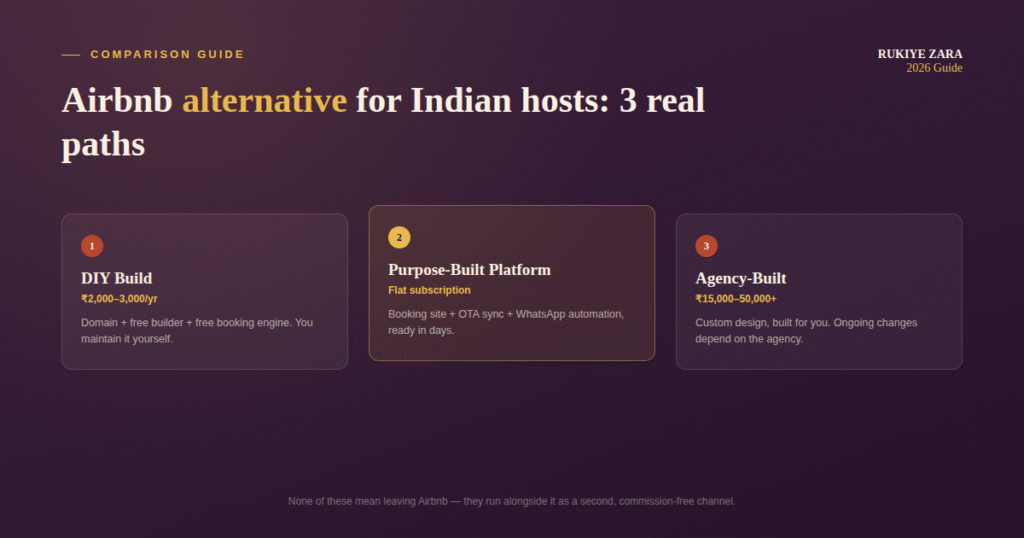
Path 1: DIY — build it yourself
What it looks like: A domain (~₹800/year), basic hosting (~₹1,200-1,500/year), a free website builder like WordPress, and a free-tier booking engine (Beds24, Hostfully’s free plan) bolted on for calendar and inquiry handling.
Cost: Roughly ₹2,000-3,000/year total, plus your own time.
What you get: A working, bookable web presence for close to nothing in cash terms.
What you’re signing up for: You’re the one maintaining it — plugin updates, calendar sync issues, payment gateway setup, and troubleshooting when something breaks, usually at the worst possible moment (an inquiry coming in while your booking form is down). Free-tier booking engines also tend to cap out fast — most become genuinely useful only for 1-2 rooms before you outgrow them.
Best for: A single-room or single-property host who’s comfortable with basic tech troubleshooting and wants to start at near-zero cost.
Path 2: Hire an agency to build it
What it looks like: A local web development company builds a custom-designed site — homestay-friendly layout, room and rate calendar, a direct-booking widget, payment gateway integration (Razorpay/UPI), and sometimes channel-manager integration with your existing OTAs.
Cost: Anywhere from ₹15,000 to ₹50,000+ upfront, sometimes with an ongoing maintenance retainer.
What you get: A professional-looking, custom site without doing the technical work yourself.
What you’re signing up for: You depend on that agency for every future change — a price update, a new room type, a design tweak. If the relationship ends, you may be stuck with a site you can’t maintain yourself. Turnaround on small changes can also be slow if you’re not a priority client.
Best for: Hosts who want a fully custom look and have the budget for it, and who are comfortable with an ongoing vendor relationship.
Path 3: A purpose-built homestay platform
What it looks like: An all-in-one system designed specifically for homestay hosts — a booking website template, PMS, channel manager, and WhatsApp automation bundled together, usually on a flat monthly or annual subscription rather than commission per booking.
Cost: Typically a flat monthly fee, scaling with room count — no per-booking commission on your direct bookings.
What you get: Real-time sync across Airbnb, MakeMyTrip, and Booking.com out of the box (so you don’t lose a night to a double-booking), a booking engine actually designed around Indian guest behavior (UPI-first, mobile-first), and WhatsApp automation for confirmations and review requests — without needing to be technical yourself.
What you’re signing up for: A recurring subscription cost regardless of booking volume, and less visual customization than a fully bespoke agency build.
Best for: Hosts running 2+ rooms or multiple properties who want the OTA-sync and WhatsApp automation working immediately, without managing the technical plumbing themselves.
Side-by-side
| DIY | Agency-built | Purpose-built platform | |
|---|---|---|---|
| Upfront cost | ₹2,000-3,000 | ₹15,000-50,000+ | Usually low/no setup fee |
| Ongoing cost | Hosting only | Maintenance retainer (optional) | Flat monthly subscription |
| Setup time | Days to weeks (DIY effort) | 2-4 weeks (agency-dependent) | Days |
| Real-time OTA sync | Manual/limited | Sometimes included | Built-in |
| WhatsApp automation | Manual setup | Rarely included | Usually built-in |
| Who maintains it | You | The agency | The platform |
| Best for | 1 room, low budget | Custom design priority | 2+ rooms, hands-off ops |
The commission math that makes any of these worth it
Whichever path you choose, the reason to build a direct channel at all is the same: OTAs typically take 15-20%+ of every booking. A homestay doing even ₹15-20 lakh in annual OTA revenue is handing over ₹2.5-4 lakh a year in commission. Against that backdrop, even the higher end of the agency-built option often pays for itself within the first few direct bookings it generates.
What actually matters, regardless of path
No matter which route you pick, three things determine whether your direct booking site actually converts:
- Mobile-first checkout — most Indian travelers are booking from a phone
- UPI as a native payment option, not an awkward add-on
- Real-time availability sync, so a direct booking doesn’t create a double-booking on your OTA calendars
If a solution can’t do these three things well, the fanciest design in the world won’t make up for it.
Frequently asked questions
Will building my own website hurt my Airbnb ranking or standing? No — Airbnb’s terms explicitly permit hosts to run independent booking channels. It only becomes a problem if you try to move an existing Airbnb-originated booking off-platform to avoid the fee.
Do I need a website if I’m on multiple OTAs already? Yes — a website is the one channel guests can use to book you directly by name, including repeat guests who already know and trust you. OTAs don’t give you that.
How many rooms before a purpose-built platform makes more sense than DIY? Most hosts find free DIY tools start to strain past 1-2 rooms — that’s typically the point where real-time sync and WhatsApp automation start paying for themselves in saved time and avoided double-bookings.
Can I switch paths later — start DIY and move to a platform? Yes, and many hosts do exactly that. Just make sure whatever you start with lets you export your guest and booking data, so switching later isn’t a rebuild from scratch.
Rukiye Zara is a purpose-built booking and management platform for Indian boutique and homestay owners — built by an Airbnb Superhost (1,500+ reviews) who’s run this exact channel-mix decision herself.