



Uttarakhand’s homestay policy has moved twice in 2026 — first in January, then again with a cabinet-approved revision in May. If you registered a few years ago, or you’re starting fresh, the rules you’ll actually be working under today are different from what you might have read even a few months back. Here’s where things stand now.
What changed in 2026
Uttarakhand originally regulated homestays under the Guest Uttarakhand Home Accommodation (Homestay) Rules, 2015, alongside the broader Uttarakhand Tourism and Travel Trade Registration Rules, 2014. Two updates this year reshaped how that works in practice:
January 2026: The Tourism Department merged the homestay scheme with the Bed & Breakfast (B&B) program under a single Tour & Travel policy framework, and made registration renewal mandatory every five years across the board.
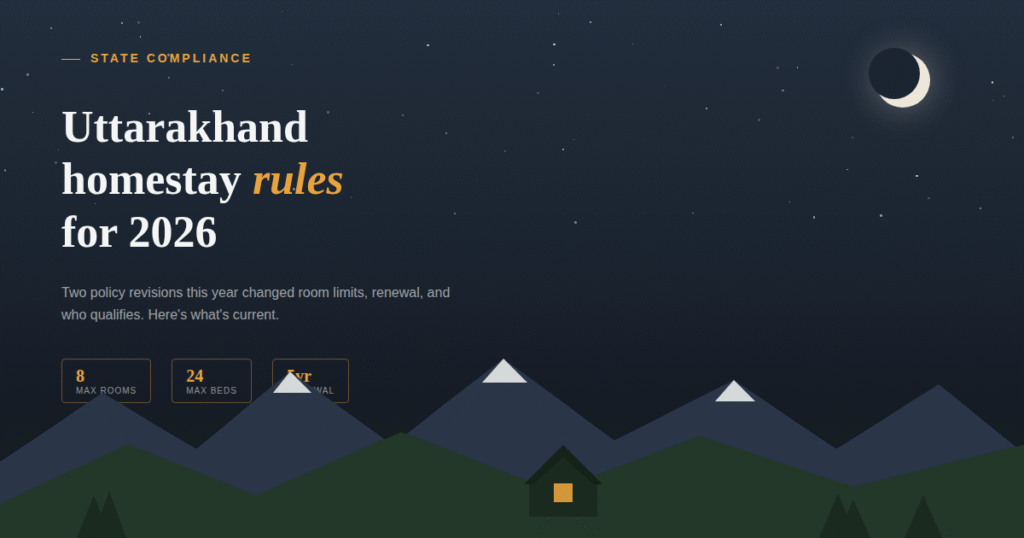
May 2026: The state cabinet approved a further revision — consolidating the travel, registration, and homestay frameworks into one comprehensive structure, raising the maximum room limit from six to eight rooms (up to 24 beds), and simplifying renewal into a self-service process, removing the earlier requirement to seek fresh government approval each cycle.
The practical effect: registration is easier to renew than it was even a year ago, but the eligibility rules around who can register as a “homestay” (versus a B&B) have gotten stricter.
Homestay vs. B&B — the distinction that decides your category
This is the detail that trips up the most hosts in Uttarakhand right now. The state draws a hard line between two categories:
- Homestay: reserved for permanent residents of Uttarakhand who own the property and personally reside there with their family. This is the category built for genuine owner-operators.
- Bed & Breakfast (B&B): the category for outsiders, non-permanent residents, or anyone operating through a caretaker rather than living on-site.
If you own a property in Uttarakhand but manage it remotely through staff rather than living there yourself, you’ll register under the B&B scheme, not the homestay scheme — and the two carry different scope and benefits, even though the physical setup might look identical.
Eligibility and room limits
Under the current framework:
- Owner-occupancy is mandatory for the homestay category — the owner (or lessee, if the building is leased) must reside there with their family.
- 1 to 8 guest rooms may be rented out, up from the earlier 6-room cap, with a maximum of 24 beds total.
- Registration is generally permitted within Nagar Panchayats (town councils) and rural areas — this is where the homestay scheme is specifically targeted, as distinct from larger urban municipal corporations.
- Each guest room should have an attached bathroom and meet basic sanitation and safety standards.
Documents you’ll need
- Ownership proof of the residential building (or lease documents, if applicable)
- Consent letter from co-owners, if ownership is joint
- Identity proof of the applicant
- Property photographs
- Fire safety compliance documentation
- Police verification, arranged through your local police station
Requirements can vary slightly by district, so it’s worth checking with your District Tourism Office before finalizing your application.
The registration process
- Prepare your documents — ownership papers, ID proof, and co-owner consent (if joint ownership) first, since these take longest to assemble.
- Apply through the Uttarakhand Tourism Homestay Registration portal, or in person at your District Tourism Development Officer (DTDO) office.
- Submit your form, documents, and property photographs.
- Inspection. A small committee — typically a tourism officer alongside a local authority representative — visits to verify the property. This is generally described as a straightforward, basic check rather than an exhaustive audit.
- Registration certificate issued, valid under the current 5-year renewal cycle.
- Renew via self-service when due — the May 2026 revision removed the older requirement of seeking fresh government approval for each renewal.
Ongoing compliance — don’t skip this part
Registration isn’t the end of the paperwork. Uttarakhand requires active homestays to:
- Maintain a detailed guest register at all times
- Report guest details to local police and the District Tourism Development Office by the 5th of every month
- Keep fire safety and hygiene standards current, not just at initial inspection
- Register separately for FSSAI (roughly ₹100/year for basic registration) if running a commercial kitchen
Skipping the monthly guest-reporting requirement is one of the more common compliance gaps among smaller hosts — it’s easy to forget once the initial registration excitement fades.
Where Uttarakhand’s homestays are concentrated
For context: Uttarakhand has over 6,000 registered homestays, with Nainital leading the state, followed by Dehradun and Pithoragarh. The scheme’s core intent — supporting rural, resident-run tourism rather than absentee-owned commercial rentals — is precisely why the homestay/B&B split exists and why it’s being enforced more clearly through 2026’s revisions.
Frequently asked questions
Can I register as a homestay if I don’t live in Uttarakhand full-time? No — the homestay category requires the owner (or lessee) to personally reside in the property with their family. Non-residents or caretaker-run properties fall under the B&B scheme instead.
How many rooms can I register now? Up to 8 rooms and 24 beds total, following the May 2026 revision — up from the earlier 6-room limit.
How often do I need to renew registration? Every 5 years, though the process is now self-service rather than requiring fresh government approval each time.
What happens if I don’t report guest details monthly? You’re required to report to local police and the District Tourism Development Office by the 5th of each month — this is an ongoing compliance obligation, not a one-time step, and is a common area where hosts fall out of compliance.
Where do I actually apply? Through the Uttarakhand Tourism Homestay Registration portal, or by applying directly to your District Tourism Development Officer (DTDO).
Getting your registered homestay booking-ready
Once you’re compliant, the next question is building a direct-booking channel that doesn’t hand 15-20% of every stay to an OTA — particularly relevant in a state like Uttarakhand where rural, resident-run hosting is exactly the kind of business the scheme was designed to support.
Rukiye Zara is a booking and management platform built by an Airbnb Superhost (1,500+ reviews) for Indian boutique and homestay owners, including hosts across Uttarakhand.