



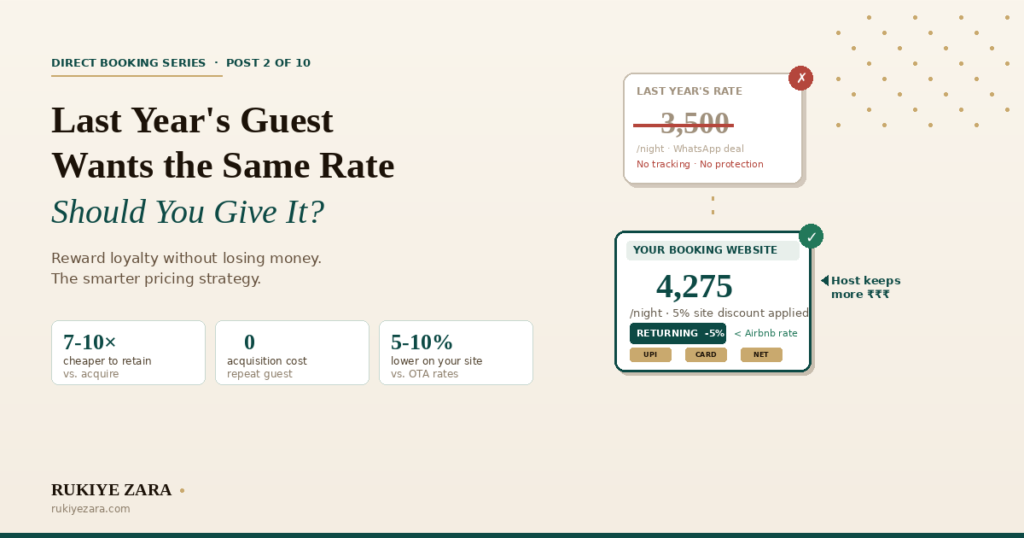
“Bhaiya, we stayed with you in Diwali last year. ₹3,500 per night. Same rate this year?”
Every homestay host in India has received this message. Sometimes it’s a WhatsApp text. Sometimes the guest just assumes it’s the same and shows up expecting last year’s price. And you’re stuck — do you honour the old rate and eat the difference, or do you risk losing a guest who already loves your place?
The answer isn’t “yes, same rate” or “no, rates have changed.” It’s something smarter. And it starts with understanding what repeat guests are actually worth to your business.
Why repeat guests are the most valuable guests you have
Let’s start with the numbers that matter.
Acquiring a new guest through Airbnb costs you 15–20% of the booking value in commission. Acquiring them through Google Ads or Instagram can cost ₹500–₹2,000 per booking depending on your market. That’s money spent before the guest even arrives.
A repeat guest? They already know your place. They’ve stayed, they liked it, they’re coming back. Your acquisition cost is zero. No platform commission. No ad spend. No influencer fee. Just a WhatsApp message that takes 30 seconds to send.
This is why saying “sorry, rates have changed” and leaving it at that is a mistake. You’re pushing away the cheapest, most reliable source of bookings you have.
But giving them last year’s exact rate is also a mistake. Here’s why.
Why “same rate as last year” doesn’t work
Your costs went up. Electricity, water, supplies, staff, maintenance — everything costs more than it did 12 months ago. If you froze your rates at last year’s price, you’d be making less on every booking while spending more to deliver it.
Here’s what typically changes year over year for a homestay:
- Utilities: Electricity tariffs in most Indian states have gone up 5–10% annually
- Supplies: Toiletries, linen replacement, kitchen consumables — all inflating
- Staff costs: If you have a cook, housekeeper, or caretaker, their pay goes up too
- Platform fees: Some OTAs have quietly raised their commission rates
- Demand: If your area is growing in popularity, your rate should reflect that
A guest who stayed at ₹3,500 last Diwali might need to pay ₹4,000 this Diwali. That’s not greed — that’s inflation. But telling a loyal guest “price went up ₹500, take it or leave it” feels harsh. There’s a better way to frame this.
What to offer instead: a better deal, not the old deal
The goal isn’t to match last year’s price. It’s to make the repeat guest feel valued while keeping your margins healthy. Here’s how to think about it:
✗ What doesn’t work
- Freezing last year’s rate forever — your margins shrink every season
- Negotiating on WhatsApp every time — eats your time, inconsistent pricing
- Saying “rates changed” with no alternative — feels like rejection
- Custom pricing for every repeat guest — impossible to manage at scale
✓ What works
- Keep your direct booking website prices consistently lower than OTA prices
- Run site-wide discount codes — DIWALI15, MONSOON10, RETURNING
- Add last-minute offers that grab attention and fill gaps
- Let them see all your rooms and properties in one place
The shift is this: instead of negotiating rates one guest at a time over WhatsApp, you create a system where your best prices are always on your own booking website. Every repeat guest gets a better deal than Airbnb — automatically, without you doing anything.
Keep your direct booking prices lower — and manage everything from one place
Here’s the setup that works:
The result: when a repeat guest messages you asking about rates, you don’t negotiate. You just send them your website link. “Rates are up to date on our site — and they’re always lower than Airbnb. Check out the RETURNING code for an extra discount.”
That’s a 15-second WhatsApp reply that closes the sale.
The Airbnb problem: one listing at a time
Here’s something that costs hosts bookings every single day, and most don’t realise it.
When a guest finds you on Airbnb, they see one listing. If you have a cottage, a treehouse, and a garden room, the guest sees whichever listing they clicked on. To see the others, they have to go to your host profile, scroll through your listings, and check each one individually — availability, photos, pricing. One at a time.
Most guests won’t do that. They’ll see your cottage is booked on their dates and leave. They’ll never know the treehouse was available.
When a guest visits your direct booking website, they see all your rooms, all your units, all your availability and rates — at a glance. The guest checking your Kasol cottage also discovers you have a riverside tent. The one looking at your Nainital room sees you’ve just listed a new property in Varkala. That’s how you increase booking value without spending a single rupee on marketing.
For repeat guests, this is especially powerful. They stayed in your standard room last time. Now they see you have a premium suite. Or a new property in a different location. Or a long-stay rate they didn’t know about. Your website becomes a discovery engine for your own inventory.
The conversation script that actually works
Here’s how to handle the “same rate?” message without awkwardness:
“Hey [Name]! Great to hear from you — we loved hosting you last time. Rates have been updated for the season, but you’ll always find the best price on our website. It’s lower than Airbnb, and there’s a discount code too: RETURNING. Here’s the link: [your booking website]. You can check all our rooms and availability there. Let me know if you need anything!”
This does four things: acknowledges the relationship, doesn’t apologize for higher rates, directs them to a system that handles pricing automatically, and introduces your other inventory. All in one WhatsApp message.
Why this is better than negotiating every time
Let’s be real about what happens when you negotiate rates on WhatsApp for every repeat guest:
- Guest A got 10% off because they asked nicely. Guest B got 15% off because they threatened to go to another stay. Guest C got the old rate because you felt guilty. Now you have three guests paying three different rates for the same room on the same weekend.
- You can’t remember who you gave what discount to. Next year, Guest A expects 10% off again. Guest B expects 15%. And now Guest A’s friend wants 15% too because “B told me he got 15%.”
- You spend 20 minutes on each negotiation. With 10 repeat guests a month, that’s over three hours of WhatsApp back-and-forth just on pricing.
A booking website with consistent pricing and site-wide discounts eliminates all of this. The rate is the rate. The discount code is the discount code. Everyone gets the same fair deal. You spend zero time negotiating.
The math: what you actually keep
Let’s say your rate this season is ₹5,000/night and a repeat guest books for 3 nights.
Read that again. The guest pays less than Airbnb. You keep more than both Airbnb and the old-rate WhatsApp deal. And the booking is properly tracked with payment secured through a real system — not a screenshot of a UPI transfer.
Commission on your booking engine? Only on booking engine bookings — never on OTA bookings. And from the Pro plan: zero commission on your direct bookings. Use the pricing calculator to see exactly what you’d save.
Build the habit: make direct booking the default for returning guests
The first time a guest books through Airbnb, fine — that’s how they found you. But by the time they’re messaging you on WhatsApp asking about rates, they don’t need Airbnb anymore. They know you. They trust you. They just need a way to book.
Here’s how to build the direct booking habit:
- At checkout: Share a card or message with your website URL. “Next time, book direct for the best rate.”
- Follow-up message: A week after checkout, send a thank-you on WhatsApp with your website link. Nothing salesy — just “hope you had a great time, here’s where to book next visit.”
- Seasonal nudge: When their favourite season approaches, message them with your website link. “Diwali is filling up — best rates on our site.”
- Friends and referrals: “Your friend wants to book? Send them our website — they’ll get the best rate there.”
Over time, your repeat guests stop thinking “let me check Airbnb” and start thinking “let me go to their website.” That’s the shift that changes your business — because every direct booking compounds. More reviews on your site. More credibility. More guests booking direct. A flywheel that you own.
Stop negotiating rates on WhatsApp
Build a booking website with rates lower than OTAs, site-wide discounts, and all your properties in one place. Repeat guests get a better deal. You keep more per booking.
Launch your booking website →What about rate parity? Can I really price lower on my own site?
Yes. Airbnb does not enforce rate parity — you’re free to set different prices on your own booking website. Many hosts keep their direct rate 5–10% below their OTA rate and never have an issue.
Booking.com has a rate parity clause in some markets, but in practice, enforcement is minimal for independent properties and homestays. The key is that your own website is your channel — you can price it however you want.
With a channel manager through Rukiye Zara, you manage all your rates from one dashboard. Update once, it syncs everywhere — Airbnb, Booking.com, and your own site. Set a rule to keep your website rate 8% lower, and forget about it. It happens automatically.
Frequently asked questions
Should I give a repeat guest the exact same rate as last year?
What discount should I offer repeat guests?
Can I create different coupon codes for different occasions?
How do I stop guests from always expecting a lower rate?
What if a repeat guest insists on paying via UPI on WhatsApp?
Will Airbnb penalise me for pricing lower on my own website?
- Guest wants to pay on UPI/WhatsApp — should you accept?
- A guest from last year wants the same rate — should you give it? (You are here)
- Airbnb suspended my listing — now what?
- My Airbnb isn’t making money anymore — what changed?
- How to increase Airbnb bookings in 2026
- Direct bookings vs. OTA bookings — the honest math
- Why repeat guests should book you direct
- You missed an inquiry and lost the booking
- How to start a homestay business in India in 2026
- Can you quit your 9–5 and live off homestay income?
Also read: Why every Indian stay needs a direct booking website · How Airbnb’s commission works in India