



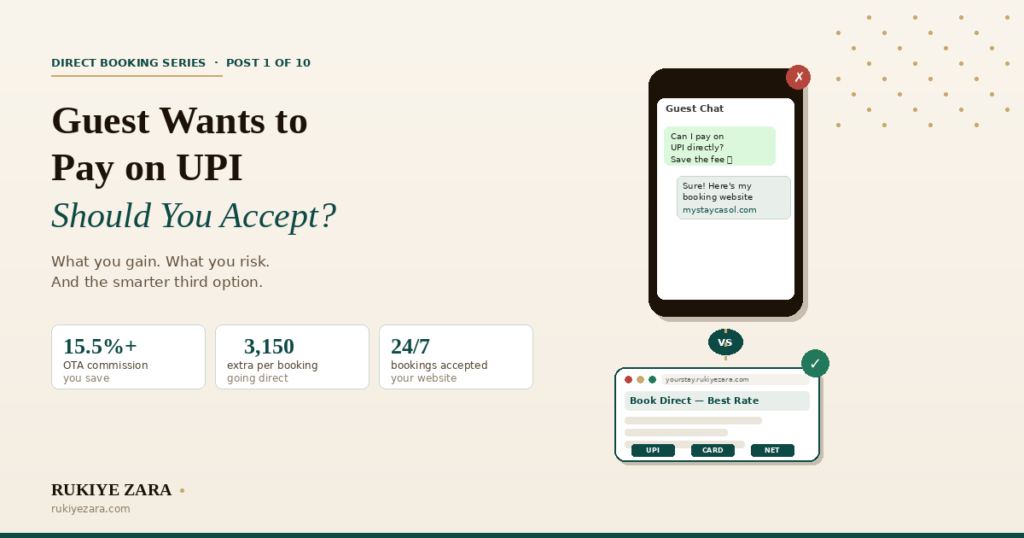
It starts with a friendly message. “Bhaiya, can I pay directly on UPI? I’ll save the service fee and you’ll get the full amount.” Or sometimes it’s the host thinking: why am I giving 15% to Airbnb when this guest is already chatting with me on WhatsApp?
If you’re a homestay or vacation rental host in India, this has happened to you. Maybe last week. Maybe today.
The short answer is: yes, off-platform payment makes both sides more money. But the way most hosts do it right now — screenshot of a QR code in WhatsApp DMs — comes with real risks that nobody talks about until something goes wrong.
There’s a smarter way to handle this. Let’s break it down honestly.
Why guests ask to pay off-platform
Let’s be real — it’s about money. On both sides.
When a guest books a ₹5,000/night stay for three nights on Airbnb, they pay roughly ₹16,700–₹17,500 depending on the service fee percentage. The host receives about ₹12,700 after Airbnb’s host-side commission. That’s a gap of ₹4,000–₹4,800 that neither of you sees.
The guest knows UPI is instant and free. You know your Google Pay handle by heart. It feels like a no-brainer.
But it’s worth looking at what each side actually gains and loses before you hit “accept” on that payment request.
What you gain — and what you lose
✓ What you gain
- Save 15–20% in OTA commissions (Airbnb charges 3% host + 14%+ guest, totalling 15.5%+)
- Get paid instantly to your bank — no 24-hour hold
- Full control over pricing — offer a small discount and still keep more
- Direct relationship with the guest for future bookings
✗ What you lose
- No Aircover protection — guest damages property, you’re on your own
- No review — the booking never happened on Airbnb, so no review gets posted
- No resolution centre — disputes go to… WhatsApp arguments
- No cancellation policy enforcement — guest cancels last minute, you chase the refund yourself
- Risk of listing suspension — Airbnb actively detects off-platform transactions
That last point deserves its own section.
Can Airbnb actually ban you for this?
Yes. And they do.
How do they detect it? Several ways:
- Message scanning: If you share a UPI ID, phone number, or payment link in Airbnb messages, their system flags it automatically.
- Booking pattern analysis: Guest inquires, you chat extensively, then the guest never books — done repeatedly, it triggers a review.
- Guest reports: Sometimes a guest who had a bad experience reports that payment happened off-platform. Now you’ve lost both the guest relationship and the listing.
Airbnb doesn’t catch every off-platform transaction. But when they do catch one, the penalty isn’t a warning — it’s often a suspension. We’ve covered what to do if that happens in our guide on understanding Airbnb’s commission structure in India.
The actual problem: you don’t have a second channel
Here’s what most hosts miss. The impulse to take UPI payments via WhatsApp isn’t wrong — it’s a sign that you need your own booking channel.
Think about it:
- You’re running Instagram ads for your stay — where do you send people? Back to Airbnb, where you pay 15% commission on the guest you brought in?
- An influencer posts about your property — their followers land on your Airbnb listing and you still pay full commission?
- You rank on Google for “homestay in Kasol” — and the booking goes through an OTA that charges you for a guest that found you organically?
Every marketing rupee you spend — on SEO, social media, influencer collaborations, Google Business Profile — is wasted if it funnels into a platform that charges you commission on the traffic you generated.
The fix isn’t sneaking payments through WhatsApp. It’s having your own booking website where guests can find you, see your availability, and pay securely — with UPI, cards, netbanking, even international payments — without either side worrying about platform rules.
The third option: your own direct booking website
This is where the math changes completely.
You give the guest a better price. You keep more money. The booking is tracked. Payment is secured. Everyone wins.
With Rukiye Zara, your booking engine accepts UPI, credit/debit cards, netbanking, and international payments — the same methods guests already use. Partial payment options are available too, so you can collect an advance at booking and the rest at check-in. No more chasing guests for money. No more multiple knocks on the door to collect payment.
Commission? Only on booking engine bookings — never on OTA bookings. And from the Pro plan: zero commission on your direct bookings.
Your booking website builds trust over time
Here’s something hosts overlook: when guests book through your own website, they can leave you a review — directly on your site. Over months, your booking website builds its own review profile. New visitors see real reviews from real guests, which builds trust independent of any OTA.
This is your own asset. It doesn’t disappear if an OTA changes its algorithm or suspends your listing. Those reviews, that trust — it belongs to you.
One place to show everything you offer
On Airbnb, a guest sees one listing. If you have multiple rooms, units, or properties, they need to visit your profile and check each listing one by one — availability, pricing, photos — switching back and forth. Most guests won’t bother.
Your own booking website shows everything in one place. All your rooms, all your availability, all your rates. A guest checking out your Kasol cottage also discovers you have a treehouse. That’s how you increase booking value without spending a rupee on marketing.
Keep your OTAs for what they’re good at
This isn’t a “delete your Airbnb” post. OTAs are still the best discovery engine for new guests — especially international travellers who don’t know your brand yet. Aircover has genuine value for high-risk bookings. And the review flywheel on established platforms matters for visibility.
The smart approach is layered:
When off-platform payment is actually fine
Not every off-platform transaction is risky. There are situations where paying directly makes sense for both parties:
- Repeat guests: They’ve stayed before, you trust each other. Send them your booking website link. They book direct, get a better rate through a coupon code, you save on commission. Everyone’s happy.
- Friends and family of past guests: “My friend stayed with you last year, she recommended you.” These referral guests shouldn’t go through an OTA — send them your website link.
- Extended stays: A guest wants to stay for 2+ weeks. The OTA commission on a ₹1.5 lakh booking is ₹23,000+. That’s a lot of money for a platform that just sent a message.
- Corporate bookings and group stays: Companies and groups prefer invoiced payments, partial advances, and direct communication. OTAs aren’t designed for this.
In every one of these cases, the smart move is to route the booking through your own website — not through a WhatsApp screenshot of a QR code. The booking gets tracked, payment is secure, and the guest gets a proper confirmation with all the details.
What about WhatsApp inquiries?
WhatsApp is where Indian hospitality happens. Guests ask questions, send photos of their group, negotiate dates — all on WhatsApp. That’s not going to change, and it shouldn’t.
But when the conversation reaches “okay, let’s book” — that’s when you share your booking website link. The guest clicks, picks their dates, sees the rate, applies a coupon if they have one, and pays. You get a notification. Done.
No more screenshotting UPI confirmations. No more manually tracking who paid what. No more “bhaiya, I sent the money, please check” messages at 11 PM. Your WhatsApp conversation stays personal and helpful. The transaction happens on a proper system.
Set up a WhatsApp Business auto-reply for when you can’t respond immediately: “Thanks for reaching out! I’ll reply soon. Meanwhile, check availability and book directly at [your website link] — you’ll get the best rate.” This captures bookings even when you’re asleep, travelling, or hosting other guests.
What this actually costs
Here’s the honest bit. A booking website isn’t free — but it’s dramatically cheaper than OTA commissions.
With Rukiye Zara, plans start at a monthly subscription that’s less than the commission on a single weekend booking. Use the pricing calculator to see exactly what you’d save based on your average booking value and volume.
The maths is simple: if your stay does even one direct booking a month through your own website, the platform pays for itself. Everything beyond that is pure savings.
And the benefits compound over time. Each guest who books direct might leave a review on your website. Each review builds credibility. Each credible website converts more visitors into bookings. It’s a flywheel that belongs to you — not to Airbnb’s algorithm.
Stop sending guests to a QR code in WhatsApp
Build a booking website that accepts UPI, cards, and international payments. Collect partial advances. Track every booking. Keep more of what you earn.
Launch your booking website →The bottom line
The guest who wants to pay on UPI is telling you something important: they want a cheaper, simpler way to book your stay. You should give them one — just not through an informal WhatsApp transaction that puts your listing and your money at risk.
Build your own booking channel. Keep your OTA listings for new guest discovery. Route your Instagram, Google, and WhatsApp traffic to your own website. Offer a small discount for direct bookings. Collect reviews on your own platform.
You’ll keep more money per booking, build an asset you own, and never have to worry about an OTA suspension taking down your entire business.
That’s not anti-Airbnb. It’s just smart hosting.
Frequently asked questions
Is it illegal to accept UPI payments from Airbnb guests?
Can I keep lower prices on my own website than on Airbnb?
What if a guest books on my website and damages property?
How do I get international guests to pay on my own website?
Will I lose all my Airbnb reviews if I move bookings off-platform?
Can guests pay in parts — advance now, rest at check-in?
- Guest wants to pay on UPI/WhatsApp — should you accept? (You are here)
- A guest from last year wants the same rate — should you give it?
- Airbnb suspended my listing — now what?
- My Airbnb isn’t making money anymore — what changed?
- How to increase Airbnb bookings in 2026
- Direct bookings vs. OTA bookings — the honest math
- Why repeat guests should book you direct
- You missed an inquiry and lost the booking
- How to start a homestay business in India in 2026
- Can you quit your 9–5 and live off homestay income?
Also read: Why every Indian stay needs a direct booking website · The real cost of OTA commissions in India