


What you actually keep from an Airbnb booking
Let’s work with a ₹10,000/night booking — a common rate for a well-reviewed homestay in a popular Indian destination.
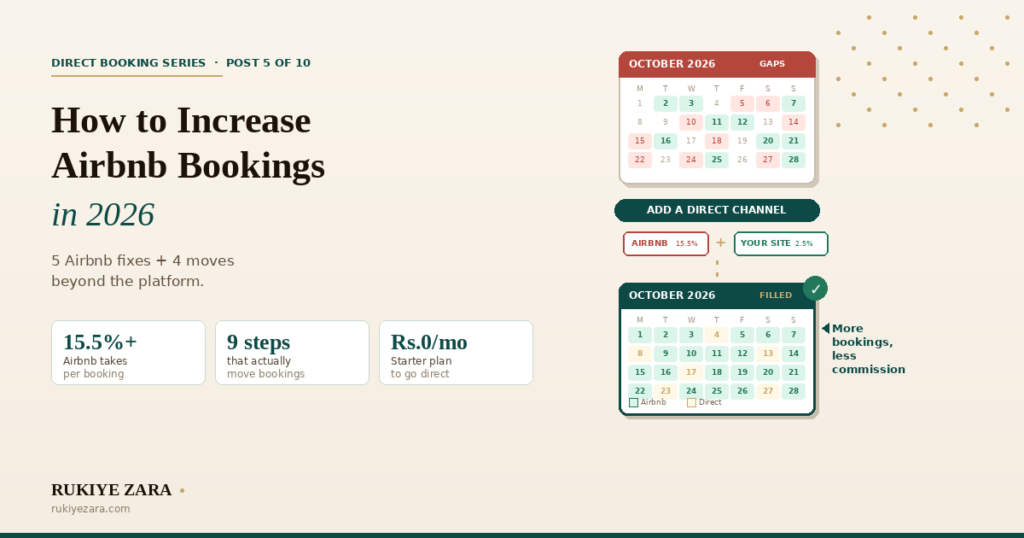
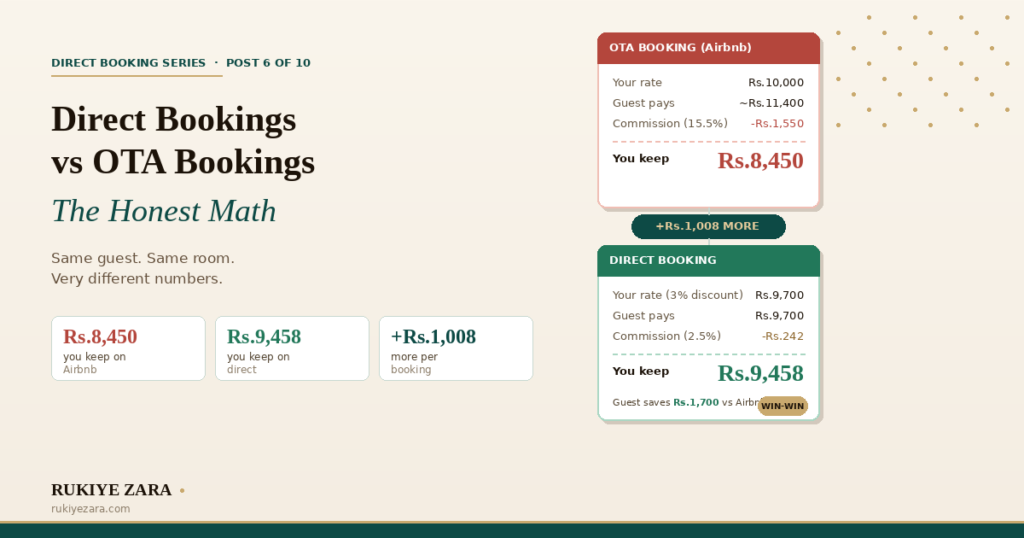
On Airbnb, the platform charges a host commission of roughly 15.5% (3% host service fee + 12–14% that comes out in how the pricing works with guest fees). On a ₹10,000 booking, you receive approximately ₹8,450.
Meanwhile, your guest is paying more than ₹10,000. Airbnb adds a guest service fee of about 14% on top of your rate — so your ₹10,000 room actually costs the guest around ₹11,400. They’re paying ₹11,400, you’re getting ₹8,450, and Airbnb keeps almost ₹3,000 from a single night’s booking.
That’s the cost of distribution. Airbnb found the guest, handled the trust layer, processed the payment. Fair enough for a guest who had never heard of you. But is it fair for the guest who found you on Instagram? Or the one who stayed with you last Diwali and wants to come back?
What you keep from a direct booking
Now imagine that same guest books through your own website. You decide to offer a small discount — say 3% off your Airbnb rate — as a reason to book direct. So the guest pays ₹9,700 instead of ₹11,400 on Airbnb. They’re saving over ₹1,700 right there.
On Rukiye Zara’s Starter plan, you pay a 2.5% commission on that booking — ₹242. That’s it.
You gave the guest a discount and you’re keeping ₹1,008 more per booking. The guest saved ₹1,700 compared to what they’d pay on Airbnb. Nobody lost — except the middleman who wasn’t needed for this particular booking.
And if you’re on the Pro plan? Zero commission on your booking engine. You keep the full ₹9,700.
Side by side: the real numbers
| Airbnb booking | Direct booking | |
|---|---|---|
| Your rate | ₹10,000 | ₹9,700 (3% discount) |
| Guest actually pays | ~₹11,400 | ₹9,700 |
| Platform commission | ~₹1,550 (15.5%) | ₹242 (2.5%) |
| You keep | ₹8,450 | ₹9,458 |
| Guest saves | — | ₹1,700 |
| Guest data stays with | Airbnb | You |
The numbers don’t need commentary. A guest books the same room, at a lower price, and you make more money. That’s not a tradeoff — that’s just better math.
Scale it up: what this means over a year
The per-booking difference matters, but it compounds fast. Here’s what happens when a portion of your bookings shift to direct over time.
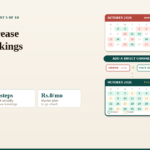
That’s nearly ₹50,000 a year extra — by shifting just 4 out of 10 bookings to direct. The room was going to be booked anyway. The guest was going to stay regardless. The only variable is who sits in the middle.
And remember: the Starter plan is free. There’s no monthly fee eating into that difference. You’re ahead from booking number one.
When OTA bookings still make sense
This isn’t an argument to quit Airbnb. OTAs earn their commission in specific situations:
- New guests who’ve never heard of you. Airbnb and Booking.com have massive search traffic. A traveller planning a Varkala trip who types “beachfront homestay” into Airbnb — that’s discovery you can’t easily replicate on your own.
- International guests. Overseas travellers trust Airbnb’s payment protection, review system, and cancellation policies. Your first booking from a guest in Germany or the US will almost certainly come through an OTA.
- Early listings. If you’ve just started hosting and have no reviews or social presence, Airbnb’s trust layer does the heavy lifting. Pay the commission, build your review base, and then start directing returning guests to your own channel.
The key: OTAs are a discovery engine. They’re good at introducing your property to strangers. They’re expensive for guests who already know you.
When direct bookings make more sense
Some bookings should never go through an OTA — because you’re already doing the work Airbnb charges for:
- Repeat guests. They’ve already stayed with you. They know your place, they trust you, they don’t need reviews. A returning guest who books through Airbnb is paying a service fee for trust they already have — and costing you 15.5% on a relationship you built.
- Social media followers. If someone found you on Instagram, watched your Reels, and DM’d you asking about availability — point them to your booking website, not your Airbnb listing. You brought them in. You should keep the revenue.
- WhatsApp inquiries. When someone messages you asking “is your place available for these dates?” — that’s a direct inquiry. Send them your booking link where they can check availability, see pricing, and pay securely.
- Referrals and word of mouth. A friend told them about your homestay. They called you directly. Sending them to Airbnb to book just so you have a “proper” booking system costs you ₹1,550 you didn’t need to pay.
The advantage you can’t put a number on
Beyond the per-booking maths, direct bookings change something structural about your business.
When a guest books through Airbnb, Airbnb owns the relationship. You can’t email them later. You can’t message them when you open a new unit. You can’t send them an off-season discount. They’re Airbnb’s customer who stayed at your place.
When a guest books through your website, you get their name, phone number, and booking history. Next off-season, you can broadcast a WhatsApp message to 200 past guests with a link to book again. Some of them will. That’s occupancy you created from a database you built — with zero commission and zero ad spend.
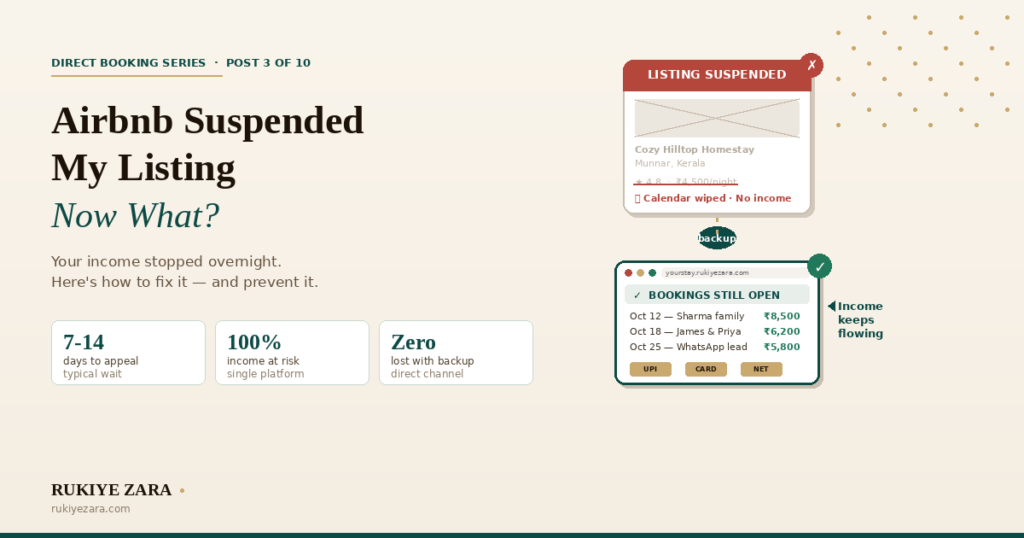
And then there’s the algorithmic risk. Your Airbnb bookings depend on Airbnb’s algorithm — which changes without notice. If they tweak the ranking factors, push “Guest Favourites,” or suspend your listing over a policy technicality, your bookings vanish overnight. Direct bookings don’t have that risk. Your website is yours, your guests are yours, your calendar is yours.
They work together, not against each other
The smartest setup: let Airbnb bring you new guests. Make sure their stay is excellent. At checkout, share your booking website. Next time they want to visit, they book direct — paying less, while you keep more.
Over time, your ratio shifts. Maybe it’s 80/20 OTA-to-direct in year one, and 60/40 by year two. You’re not losing anything — you’re keeping Airbnb for what it does best (discovery) and routing everything else through a channel that makes you more money.
A channel manager keeps your calendar synced across both, so you never double-book. One system, two channels, better economics.
See the math for your property
Your nightly rate, your occupancy, your commission savings — calculated in under a minute. The Starter plan is free.
Calculate your savings →Frequently asked questions
Won’t giving a discount on direct bookings hurt my revenue?
What about trust — won’t guests be nervous booking directly?
Is it allowed to redirect Airbnb guests to my own website?
How many direct bookings before it’s worth it?
What if I have multiple properties — does this scale?
Can I use a channel manager to handle both Airbnb and direct bookings?
- Guest wants to pay on UPI/WhatsApp — should you accept?
- A guest from last year wants the same rate — should you give it?
- Airbnb suspended my listing — now what?
- My Airbnb isn’t making money anymore — what changed?
- How to increase Airbnb bookings in 2026
- Direct bookings vs. OTA bookings — the honest math (You are here)
- Why repeat guests should book you direct
- You missed an inquiry and lost the booking
- How to start a homestay business in India in 2026
- Can you quit your 9–5 and live off homestay income?
Also read: What OTAs really cost your homestay · Airbnb’s commission rate in India explained