


Year one of running a homestay is survival. You figured out pricing by trial and error, learned to read OTA algorithms, discovered that “self-check-in” means different things to different guests, and probably had at least one double-booking panic.
Year two is different. You know the business works. Now the question is: how do you run it without it running you?
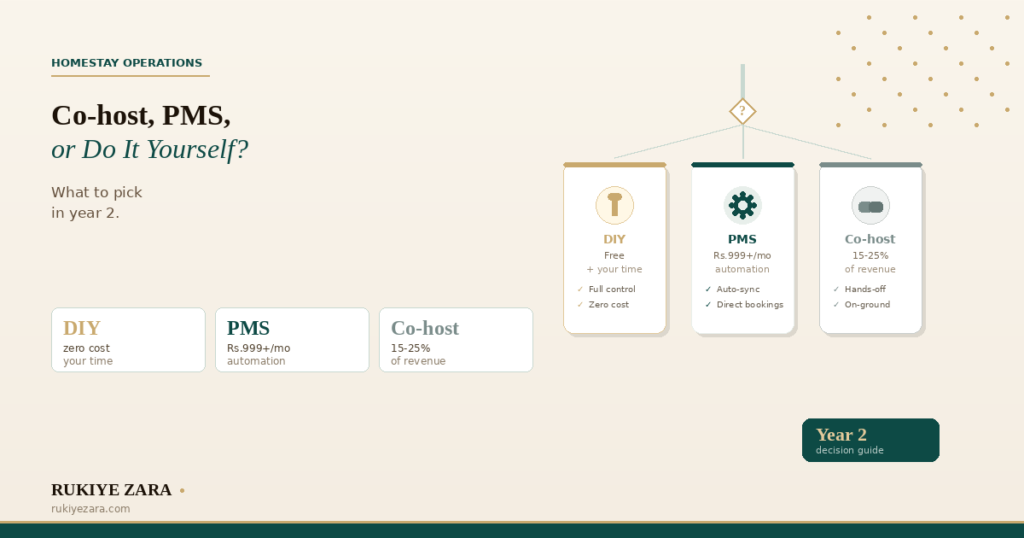
Three paths sit in front of you. Keep doing everything yourself. Hire a co-host to handle operations. Or get a PMS (property management software) to automate the repetitive parts. Each has a real cost, a real benefit, and a real trade-off — and the right choice depends on things that most “co-host vs PMS” articles never ask about.
The three options, honestly
This isn’t a “one is always better” situation. Each option solves a different problem. The mistake most hosts make is picking the option that sounds right instead of the one that matches their actual bottleneck.
What’s actually eating your time?
Before choosing, diagnose the real problem. The answer tells you which path to take.
| Your situation | The real problem | What solves it |
|---|---|---|
| You’re manually updating calendars on 2–3 OTAs | Repetitive admin work | PMS |
| You’ve had a double booking | No real-time calendar sync | PMS |
| You miss inquiries because you’re busy or asleep | Response time problem | PMS |
| You live in a different city from your property | No on-ground presence | Co-host |
| You have a full-time job and can’t take calls during the day | Availability problem | Co-host or PMS |
| You have 1–2 rooms, one OTA, and you live on-site | Nothing yet — you’re managing fine | DIY |
| You want direct bookings but don’t know how to start | No direct booking channel | PMS |
| You want to add more rooms or a second property | Scaling without more hours | PMS |
Notice the pattern. If your problem is manual work that a machine can do, a PMS fixes it. If your problem is you can’t physically be there, a co-host fixes it. If neither is your problem yet, stay DIY until it is — don’t fix what isn’t broken.
The real cost of each option
Let’s compare what each option actually costs for a 2-room homestay earning ₹1.2 lakh/month in bookings.
The numbers speak for themselves. A co-host at 20% of ₹1.2 lakh revenue costs ₹24,000/month. A PMS at ₹999–2,599/month costs a fraction of that. But here’s the thing most hosts miss: the co-host and the PMS solve different problems. Comparing their price without comparing what they do is like comparing a car and a driver — you might need one, the other, or both.
The hybrid that works: Many Indian homestay owners in year 2 land on a combination — a PMS for automation (calendar sync, booking management, direct booking website) plus a local caretaker for on-ground operations (check-ins, cleaning coordination, key handover). This costs far less than a co-host and gives you more control than full outsourcing.
The DIY ceiling — when self-managing stops working
DIY is the right answer when you’re starting out. One property, one or two OTAs, you live nearby, and the volume is manageable. The problem is that most hosts don’t notice when they’ve outgrown it. They just get busier and busier until something breaks — a double booking, a bad review from a missed message, a guest who arrived to find nobody there.
The tipping points:
You’ve outgrown DIY when any of these are true:
You’re listing on more than one OTA. You’ve had a double booking (or a near-miss). Your average response time to inquiries is over an hour. You’re spending more than an hour a day on admin — updating calendars, messaging guests, chasing payments. You want to start getting direct bookings but you’re too busy to set up the channel. You’re turning down bookings because managing more feels overwhelming.
Any one of these means the cost of DIY is already higher than the cost of a PMS — you just can’t see it because it’s measured in lost bookings, not invoices.
What a PMS actually does (and doesn’t do)
A PMS isn’t a co-host replacement. It doesn’t check in your guests, change the bedsheets, or fix a leaking tap. What it does is eliminate the admin work that eats your time and causes errors.
What a PMS handles: Calendar syncing across all your OTAs (no more manual updates, no more double bookings). A direct booking website so guests can book without an OTA. Automated guest messaging. Centralized booking management — every reservation in one place. Revenue tracking and reports.
What a PMS doesn’t handle: Physical check-ins and key handovers. Cleaning and maintenance. Grocery shopping for breakfast supplies. Being there when a guest has a problem at 11 PM.
If your bottleneck is the admin work — calendars, messages, bookings — a PMS at ₹999/month is the obvious answer. If your bottleneck is physical presence, you need a person. But most hosts find that a PMS plus a part-time caretaker (₹5,000–8,000/month in most Indian locations) covers both bases at a fraction of a co-host’s cost.
When a co-host makes sense
Co-hosting gets a bad reputation because of the cost, but there are situations where it’s genuinely the right call:
You don’t live near your property. If your homestay is in Manali and you live in Delhi, you need someone on the ground. A PMS can handle bookings, but someone needs to be there for check-ins, emergencies, and coordination with housekeeping staff.
You have a full-time career and zero bandwidth. If running the homestay has to be fully passive income, a co-host delivers that. You trade margin for time — 20% of your revenue buys you complete freedom from operations.
You’re testing a new market. Before you commit to a property in a new location, a co-host lets you test the market without relocating. If it works, you can transition to PMS + caretaker once you’ve figured out the operations.
But here’s what to watch out for: a co-host manages guest relationships on your behalf. Over time, they become the host, not you. Guests remember them, not your property. If the co-host leaves, you lose that institutional knowledge — and potentially the repeat guest relationships they built. A PMS keeps you in control even when someone else is doing the on-ground work.
The year-2 decision framework
Stay DIY if: You have 1–2 rooms, one OTA listing, you live on or near your property, and you’re spending under an hour a day on admin. Revisit in 6 months or when you hit a tipping point.
Get a PMS if: You’re on 2+ OTAs, you’ve had a double booking or missed inquiry, you want direct bookings, or you’re spending 1–2 hours daily on admin. This is the most common year-2 move.
Hire a co-host if: You live far from your property and can’t handle on-ground operations, or you need the homestay to be fully hands-off income. Consider combining with a PMS so you keep control of the data and the guest relationship.
PMS + caretaker if: You want automation AND on-ground support without giving up 20% of revenue. This is what most successful Indian homestay owners land on by year 3.
Don’t give up what you built
Here’s the thing about year 2 that nobody tells you: the guest relationships, the reviews, the listing momentum — that’s your real asset. Whatever you choose, make sure you own it.
A co-host who manages your OTA logins has leverage over your business. A PMS that holds your booking data in a format you can’t export holds your history hostage. The right tool makes you more capable without making you dependent.
The direct booking math gets better every year you operate. By year 2, you have past guests, a reputation, and a brand. The smartest investment you can make is a system that lets you convert those assets into direct bookings — where you keep the full margin and own the guest relationship forever.
Ready to move past year 1?
Rukiye Zara gives you the PMS, channel manager, and direct booking website — starting free. Keep the guest relationship. Keep the revenue.
See plansFrequently asked questions
What is a co-host and how does co-hosting work for Indian homestays?
A co-host is a person or agency that manages your homestay operations on your behalf — handling guest communication, check-ins, pricing, listing management, and sometimes housekeeping coordination. In India, co-hosts typically charge 15–25% of your booking revenue. They’re most useful when you don’t live near your property or can’t handle day-to-day operations yourself.
What is a PMS and do I need one for my homestay?
A PMS (Property Management Software) is a tool that automates tasks like calendar syncing across OTAs, guest messaging, booking management, and pricing. For a 1–3 room homestay in year one, you probably don’t need one. By year two — especially if you’re listing on multiple platforms or getting direct bookings — a PMS saves hours of manual work and prevents double bookings.
How much does a co-host charge in India?
Most co-hosts in India charge 15–25% of booking revenue. Some charge a flat monthly fee (₹5,000–15,000 depending on location and number of rooms). The percentage model means they earn more when you earn more, which aligns incentives — but at 20% of revenue on top of 15–18% OTA commission, over a third of your booking goes to intermediaries before you see it.
Can I manage my homestay myself without a co-host or PMS?
Yes — many successful Indian homestay owners manage everything themselves, especially with 1–3 rooms. The key question is how you spend your time. If you’re manually copying bookings between calendars, chasing payments on WhatsApp, and missing inquiries because you were busy, you’re not saving money — you’re losing bookings. A PMS automates the repetitive work so you can focus on the guest experience.
Should I use a PMS or hire a co-host for my Airbnb in India?
It depends on where your bottleneck is. If you’re available and willing to manage guests but drowning in manual tasks (calendar syncing, messaging, bookings), a PMS solves that at ₹999–2,599/month. If you’re not available — you live in a different city, or you have a full-time job — a co-host handles the human side. Some owners use both: a PMS for automation and a local caretaker for on-ground operations.
When should a homestay owner switch from self-managing to using software?
The tipping points are: you’ve had a double booking, you’re listing on more than one OTA, you’re missing inquiries because of response time, you want to start taking direct bookings, or you’re spending more than an hour a day on admin. Any one of these means you’ve outgrown manual management and the cost of a PMS is less than the bookings you’re losing without one.