



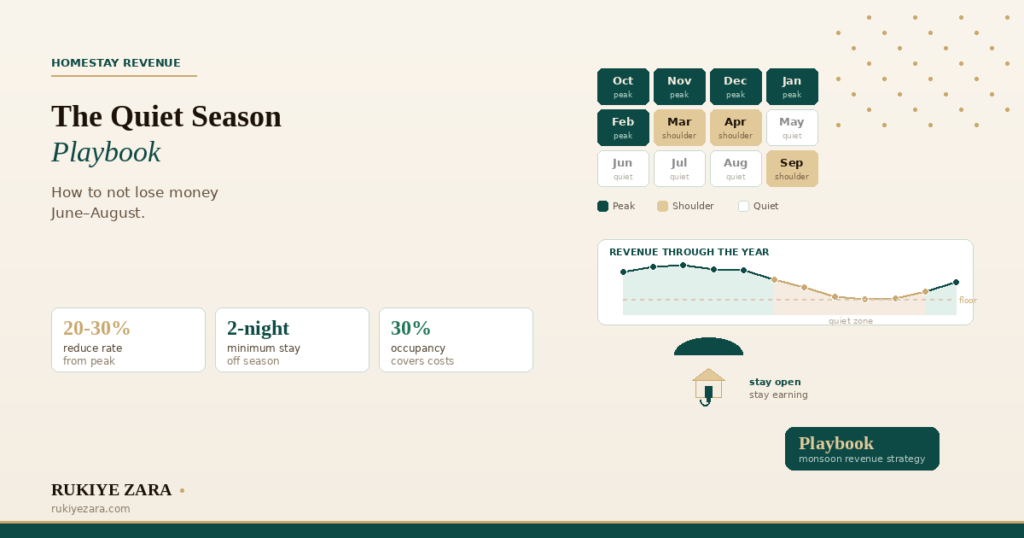
Every Indian homestay host knows the feeling. October through March, your phone buzzes constantly — inquiries, bookings, reviews. Then April tapers. By June, the monsoon hits, OTA traffic drops, and your calendar stares back at you with empty white boxes for weeks at a stretch.
Most hosts do one of two things: panic-drop their rates to ₹500 below the cheapest listing in their area, or shut down entirely and wait for October. Both are mistakes. The first attracts guests who leave bad reviews. The second burns cash — your rent, EMI, electricity, caretaker salary, and OTA subscriptions don’t pause because bookings did.
There’s a third option: treat the quiet season as a different business with different rules. Here’s the playbook.
First, know your calendar
India doesn’t have one universal “season.” Your quiet months depend on where your property is. But for most homestay destinations, the pattern looks roughly like this:
Hill stations flip this — Manali and Mussoorie are packed in May–June when the plains are 45°C. Kerala has a second surge during Onam (August–September). Goa’s monsoon is quiet for beach tourists but draws a niche crowd for off-season rates and empty beaches. Know your destination’s pattern before applying any pricing strategy.
The point: “quiet season” isn’t three months of zero demand. It’s three months of different demand — fewer guests, shorter booking windows, more price sensitivity, and a higher share of last-minute and domestic travellers.
The pricing framework that works
The biggest quiet-season mistake is pricing with emotion. You see an empty calendar, panic, and slash rates by 50%. This fills rooms — but with guests who wouldn’t pay fair value, expect a five-star hotel, and leave reviews that drag your peak-season pricing down.
Instead, use a structured approach:
| Rate type | vs. peak rate | When to use |
|---|---|---|
| Quiet-season weekday | 20–30% below peak | Your base off-season rate (Mon–Thu) |
| Quiet-season weekend | 10–20% below peak | Fri–Sun — weekend demand doesn’t vanish |
| Weekly rate | 40–45% below peak | 7+ night stays — remote workers, families |
| Repeat-guest rate | Your quiet weekday rate minus 10–15% | Direct booking only — offered via WhatsApp or your website |
| Last-minute (48h) | Same as quiet weekday | Don’t discount further — last-minute guests are already committed |
A few things to notice. First, your weekend rate should always be higher than your weekday rate, even in the off season. Weekend demand exists year-round for homestays within driving distance of metro cities. Second, the repeat-guest rate should go through your direct booking channel — not through OTAs where you’d lose another 15–20% on an already-reduced rate. Third, don’t drop last-minute rates below your standard quiet-season rate. Someone booking 48 hours before check-in has already decided — they don’t need a deeper discount.
The floor rule: Calculate your absolute minimum rate — the number below which you’re literally losing money per booking after cleaning, laundry, breakfast, and utilities. Never go below it, no matter how empty the calendar looks. For most Indian homestays with 1–2 rooms, this floor is ₹1,500–2,500/night depending on location.
Minimum stays: your quiet-season filter
One-night bookings in the off season are rarely worth it. The turnover cost — cleaning, laundry, restocking, check-in time — is the same whether a guest stays one night or three. But the revenue isn’t.
Set a 2-night minimum during your quiet months. This does two things: it filters out guests who just need a bed for one night (not your target), and it increases your average booking value without changing the nightly rate. A 2-night stay at ₹2,800/night earns more than a 1-night stay at ₹3,500 after you factor in turnover costs.
For weekly stays, offer a meaningful discount — 40–45% below peak — and market it specifically to remote workers, writers, and families on school holidays. A guest who stays 7 nights at ₹2,000/night (₹14,000 total) is more profitable than two separate 2-night guests at ₹3,000/night (₹12,000 total, with an extra turnover cycle).
Six moves for the quiet season
Message your past guests
Send a personal WhatsApp to every guest from the last 12 months. Not a broadcast — a personal message. “Hey [name], we’ve got a monsoon-special rate running if you’re up for a weekend trip.” This converts better than any OTA promotion.
Enable instant booking on OTAs
Off-season travellers book last-minute. If they have to wait for you to approve, they’ll book the listing with instant confirmation. Turn it on for your quiet months even if you prefer approval-based booking in peak season.
Target the 3–5 hour radius
Your quiet-season guest is likely within driving distance. A couple in Bangalore looking for a weekend getaway to Coorg. A Delhi family heading to Nainital for a few days. Update your listing copy to speak to this guest — “3 hours from [city]” is a powerful line.
Run a monsoon-specific listing
Update your photos and description for the season. Monsoon photos of your property — misty mornings, rain on the roof, green surroundings — attract the kind of guest who wants a rainy getaway. Don’t show them peak-season pool photos when it’s July.
Offer experiences, not just a room
A home-cooked dinner included in the rate. A guided walk to a nearby waterfall. A chai session on the verandah while it rains. Package the monsoon as the experience, not the obstacle. This justifies your rate and sets you apart from budget listings racing to the bottom.
Keep your listing active — always
Closing your listing kills your search ranking on every OTA. When you reopen, the algorithm treats you like a new listing without reviews. Stay active, even if bookings are slow. A listing with zero availability signals “popular.” A delisted property signals “gone.”
The quiet season is when you build your direct channel
Here’s what most hosts don’t realise: the quiet season is the best time to set up your direct booking channel. You have time. You have fewer guests to manage. And every piece of infrastructure you build now compounds in the peak season ahead.
What to build during the quiet months:
Set up your direct booking website — even a simple one on Rukiye Zara’s free Starter plan. Collect every past guest’s WhatsApp number into a list. Create a Google Business profile if you don’t have one. Refresh your property photos. Write or update your listing description. Respond to every review you haven’t responded to yet.
When October hits and demand surges, you don’t want to be scrambling to set this up while also managing back-to-back bookings. Do it now.
The hosts who have the best peak seasons are the ones who spend the quiet season building, not waiting. A direct booking channel with a list of past guests means that when peak season starts, you can fill your first few weeks with repeat guests at zero acquisition cost — no OTA commission, no ads, no discounting. That’s the real value of the quiet season.
The math: why staying open beats shutting down
Let’s run the numbers for a 2-room homestay that considers closing for three months (June–August).
| Shut down | Stay open (30% occupancy) | |
|---|---|---|
| Revenue (3 months) | ₹0 | ₹1,51,200 |
| Fixed costs Rent/EMI, electricity, caretaker, subscriptions |
₹90,000 | ₹90,000 |
| Variable costs Cleaning, laundry, breakfast, utilities per booking |
₹0 | ₹28,000 |
| Net | –₹90,000 | +₹33,200 |
Assumes: 2 rooms, ₹2,800/night off-season rate, 30% occupancy (roughly 27 booked nights per room over 3 months). Fixed costs at ₹30,000/month. Variable cost at ~₹500/night per room.
Shutting down costs you ₹90,000 in fixed expenses with zero income. Staying open at even 30% occupancy — less than one booking per week — covers your costs and puts ₹33,000 in your pocket. Not life-changing money, but the difference between losing ₹90K and making ₹33K is ₹1.23 lakh. That’s meaningful.
And this doesn’t count the biggest cost of shutting down: lost OTA search ranking and listing momentum that takes weeks to rebuild.
The off-season checklist
Bookmark this. Work through it over June–August so you’re fully set before October.
- Set quiet-season rates (20–30% below peak, 2-night minimum)
- Update listing photos and description for monsoon
- Enable instant booking on OTAs
- Message every past guest with a monsoon-special rate
- Set up or update your direct booking website
- Build your past-guest WhatsApp list
- Create or claim your Google Business profile
- Respond to every unresponded review
- Fix any maintenance issues (you have time now)
- Refresh bedding, towels, and amenities
- Plan your peak-season pricing and minimum stays
- Set up a booking website if you don’t have one — Starter plan is free
The bottom line
The quiet season isn’t a holiday for your business — it’s a different gear. Lower rates, longer stays, repeat guests, and local travellers keep revenue flowing. And the hosts who use these months to build their direct channel, refresh their listings, and stay visible are the ones who dominate when peak season returns.
Don’t race to the bottom on price. Don’t shut down. And don’t wait for October to start getting ready for October.
Use the quiet season to build your direct channel
Set up a booking website now — so when peak season hits, you have repeat guests booking direct at zero commission.
Launch your website — freeFrequently asked questions
How much should I reduce my homestay rates in the monsoon season?
A 20–30% reduction from your peak-season rate is standard for most Indian homestay destinations during the monsoon. Go lower and you attract the wrong guests; stay at peak rates and you sit empty. The goal isn’t to match your peak revenue — it’s to cover your fixed costs and keep some income flowing.
Should I close my homestay during the monsoon months?
Shutting down completely is rarely the right move. You still pay rent or EMI, electricity, caretaker salaries, and OTA subscription fees whether you’re open or not. Even at 30–40% occupancy with lower rates, you’re covering fixed costs and keeping your listing active. Closing also kills your search ranking on OTAs — you’ll spend weeks rebuilding visibility when you reopen.
How do I get bookings during the off season for my homestay?
Focus on three channels: repeat guests from your direct booking list (offer them a monsoon-special rate), last-minute domestic travellers on OTAs (enable instant booking and flexible cancellation), and local staycation guests within a 3–5 hour driving radius. The monsoon is also the best time to build your direct booking channel for the peak season ahead.
What is the best pricing strategy for homestays in the off season?
Use a three-tier approach: a reduced nightly rate (20–30% below peak), a minimum 2-night stay to filter out one-night bookings that aren’t worth the turnover cost, and a weekly rate at 40–45% below peak for longer stays. Weekends should still be priced 10–15% above your off-season weekday rate — weekend demand doesn’t disappear entirely.
Should I offer discounts to repeat guests during the quiet season?
Yes — repeat guests are your most valuable quiet-season asset. They don’t need convincing about your property; they just need a reason to come now. A direct message with a monsoon-special rate (even 10–15% off your already-reduced rate) often converts. This is best done through your direct booking channel, not OTAs, so you also save on commission.
How do I use the quiet season to prepare for peak season bookings?
The quiet season is the best time to set up or improve your direct booking website, refresh your listing photos, collect and respond to reviews, fix maintenance issues, update your Google Business profile, and build an email or WhatsApp list of past guests. Hosts who use the off season to build their direct channel consistently outperform in the next peak season.