


You already did the hard part
Think about what Airbnb actually does for a first-time guest: it shows them your photos, gives them reviews to read, handles the payment securely, and offers a cancellation policy they trust. That’s the discovery and trust layer — and it’s worth the 15.5% commission when a stranger from Bangalore or Berlin finds you for the first time.
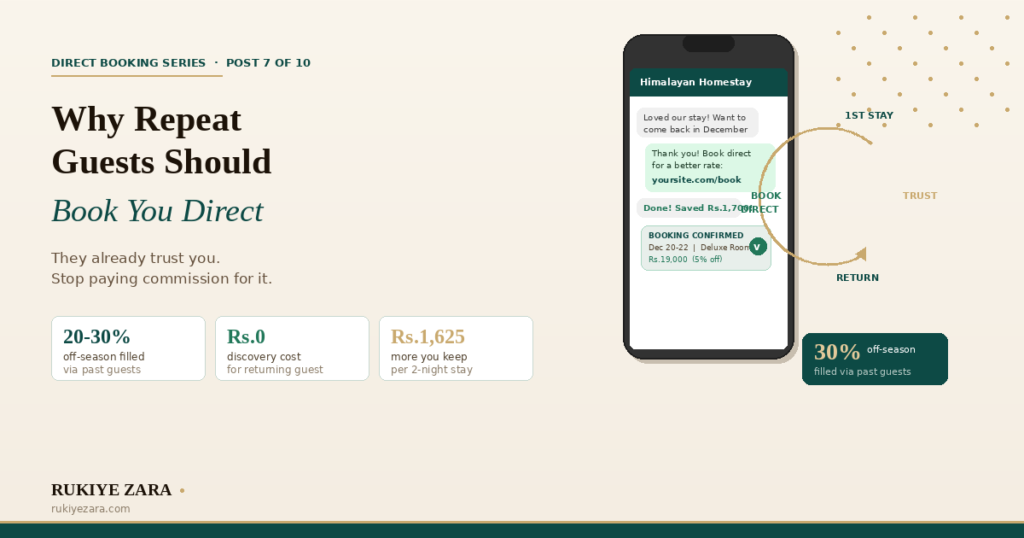
Now think about a guest who stayed with you last November. They slept in your room, ate at your table, messaged you on WhatsApp to ask where to find good coffee nearby. They left a five-star review. Six months later, they want to come back for a long weekend.
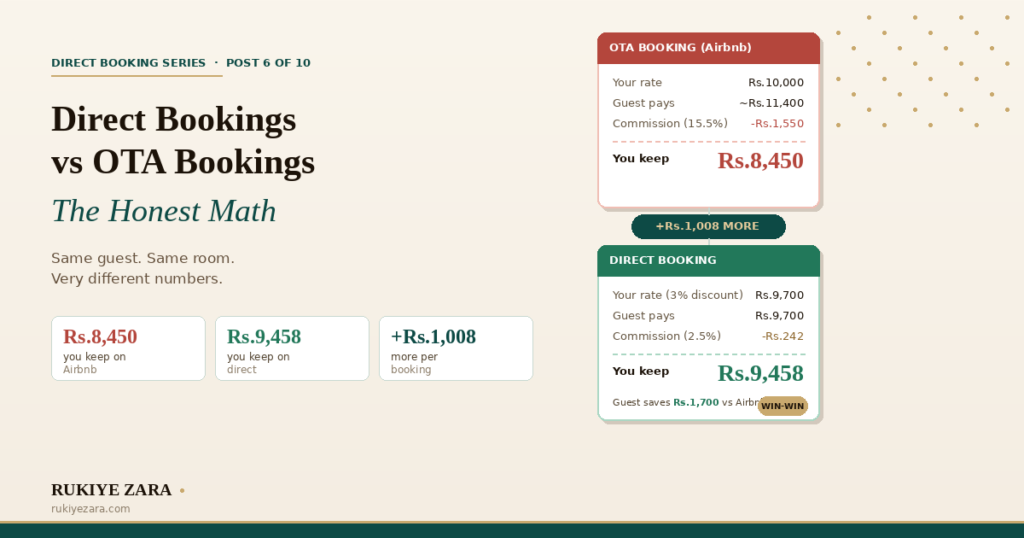
What exactly is Airbnb providing this time? The guest already trusts you. They don’t need to read reviews — they wrote one. They don’t need Airbnb’s cancellation policy — they’d message you directly if plans changed. And yet, if they book through Airbnb again, you’ll hand over ₹1,550 in commission on a ₹10,000 booking. For what?
The math on a repeat guest booking
Let’s be specific. A returning guest books your ₹10,000/night room.
You gave the guest a 5% discount — ₹1,000 off a two-night stay. They saved ₹1,000 compared to your Airbnb rate, and ₹3,800 compared to what Airbnb would’ve charged them (rate + guest service fee). Meanwhile, you kept ₹1,625 more than you would have on Airbnb.
Now multiply that by every returning guest across a year. If even 3–4 guests a month rebook directly instead of through Airbnb, that’s ₹5,000–₹6,500 extra every month — roughly ₹65,000–₹78,000 a year. For guests who were coming anyway.
How to make the switch easy
Converting a repeat guest to a direct booker isn’t a sales pitch. It’s a convenience — they get a better deal and a simpler booking process. Here’s what works:
Share your booking link at checkout
When a guest checks out, send them a WhatsApp message thanking them for the stay and include your booking website link. “Next time you want to visit, you can book directly here — same place, better price, no extra fees.” That’s it. No hard sell, just a link. Most guests save it.
Put a small discount on your website
A site-wide coupon or a returning-guest discount makes the value obvious. Even 3–5% off your Airbnb rate is meaningful to the guest (they’re also skipping Airbnb’s service fee), and it still leaves you keeping significantly more per booking. The discount pays for itself from the commission you’re no longer paying.
Leave a card in the room
A simple printed card on the bedside table or near the welcome kit: your property name, your booking website URL, and a line like “Book directly for the best rate.” Guests photograph these. When they’re planning their next trip six months later and searching through their phone for your details, that’s what they’ll find.
Add it to your WhatsApp business profile
If you’re already using WhatsApp for guest communication, put your booking website link in your business profile and auto-reply. Every guest who messages you sees a way to book directly.
Opening a new property? Your past guests are your first audience
This is where a guest database changes the game entirely.
Say you open a new unit — a second room, a cottage next to your main property, or a completely new homestay in a different destination. On Airbnb, that new listing starts from zero: no reviews, no ranking, no visibility. You’re back to waiting for the algorithm to notice you.
But if you have a booking website, your new property is already there — listed alongside your existing rooms, with live availability and pricing. A returning guest who visits your site to rebook their favourite room sees the new one right there. They check the photos, compare prices, and maybe book the new place instead. You didn’t spend a rupee on marketing.
Better still, you can actively tell your past guests about it. A WhatsApp broadcast to 100 previous guests — “We’ve just opened a new lakeside cottage in Varkala. Check availability and photos here: [your booking link]” — puts your new property in front of people who already know and trust your hosting. Some of them will book. Some will forward it to friends who are planning a trip.
Try doing that with Airbnb guests. You can’t — because Airbnb owns that guest data, not you.
Off-season? This is when guest data pays for itself
Every homestay host knows the pain of off-season: July in Goa, monsoon in the hills, mid-week lulls everywhere. Your Airbnb calendar goes quiet, and there’s nothing you can do about it except drop your price and hope the algorithm picks you up.
With a guest database, you have a different option entirely.
Take your list of past guests — everyone who’s booked with you in the last 12–18 months. Send a broadcast message:
“Hey [name], monsoon rates are live at [property name] — 20% off July and August. The hills are green, the crowds are gone. Check dates and book here: [your booking website link].”
That’s a personalised message to people who’ve already stayed with you, with a direct link where they can check availability, see the price, and book in two minutes. No algorithm, no commission-funded ads, no hoping someone finds you in a sea of search results.
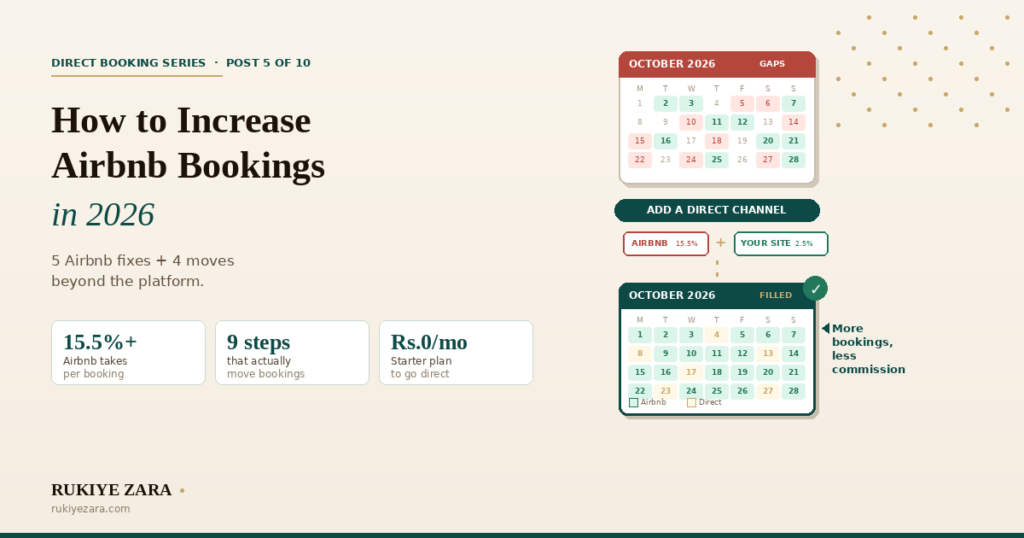
Hosts who do this consistently report filling 20–30% of their off-season occupancy from past-guest outreach alone. That’s calendar gaps filled by a WhatsApp message and a booking link.
This only works if you have the guest data. If every booking went through Airbnb, you have no phone numbers, no email addresses, no way to reach these people. Your off-season strategy becomes “lower the rate and wait.” Direct bookings, even a few per month, build the database that makes off-season manageable.
Your booking website is also your storefront
On Airbnb, each listing lives on its own page. A guest looking at your 1BHK can’t easily see your 2BHK, your deluxe room, or the new cottage you just added. They’d have to go to your profile, scroll through listings, and check availability for each one separately.
On your own booking website, everything is in one place. All your rooms, all your properties, live pricing, instant availability. A guest who came looking for one room sees four options, picks the best fit, and books — all in one visit. That’s a higher booking value from the same guest, without you doing anything extra.
For returning guests especially, this matters. “I stayed in your garden room last time — is the new upstairs suite available for Diwali weekend?” They land on your site, check it themselves, and book at a time that suits them. No back-and-forth on WhatsApp, no waiting for you to respond with rates.
This doesn’t replace Airbnb — it builds on it
Airbnb remains your best channel for new guest discovery. A stranger searching “homestay near Nainital Mall Road” will find you there, not on your booking website. Let Airbnb do what it does best: bring in first-time guests who’ve never heard of you.
But the second time that guest wants to stay? The third time? The friend they refer? Those bookings don’t need Airbnb’s discovery engine or trust layer. They need a booking link and a good rate.
Think of it as a funnel
Airbnb brings the first stay — you pay for discovery. Fair.
Your booking website handles every stay after that — the guest pays less, you keep more, and you build a database that fills your off-season and launches your new properties.
Over time, the ratio shifts. Year one: maybe 80% OTA, 20% direct. Year two: 60/40. The guests who come back and the guests who come through referrals — those are all direct. And direct bookings don’t have a margin problem.
The Starter plan is free — no monthly fee, just 2.5% on direct bookings. The first returning guest who books through your site instead of Airbnb already saves you money. Want zero commission on your booking engine? The Pro plan does that — flat fee, no per-booking charges.
Your repeat guests are waiting for a better link
Set up your booking website, share it with your next checkout guest, and start keeping the revenue you’re currently giving away. The Starter plan is free.
Launch your booking website →Frequently asked questions
How do I share my booking link without annoying guests?
Won’t Airbnb penalise me for having a direct booking website?
What percentage of guests actually rebook directly?
Can I offer different rates on my website vs Airbnb?
How do I handle off-season outreach to past guests?
What if I’m opening a new property — how do past guests help?
- Guest wants to pay on UPI/WhatsApp — should you accept?
- A guest from last year wants the same rate — should you give it?
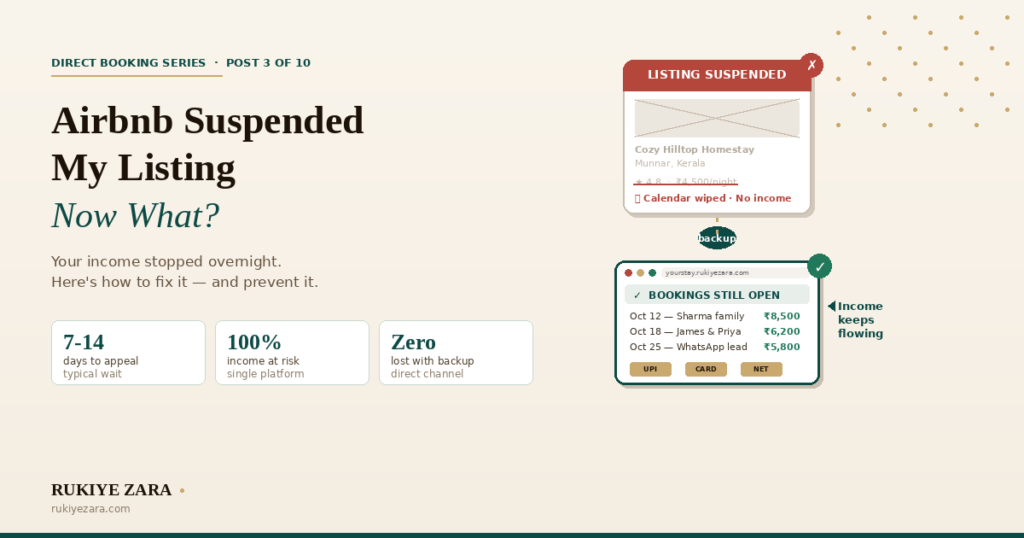
- Airbnb suspended my listing — now what?
- My Airbnb isn’t making money anymore — what changed?
- How to increase Airbnb bookings in 2026
- Direct bookings vs. OTA bookings — the honest math
- Why repeat guests should book you direct (You are here)
- You missed an inquiry and lost the booking
- How to start a homestay business in India in 2026
- Can you quit your 9–5 and live off homestay income?
Also read: How to get direct bookings for your homestay · What OTAs really cost your homestay