


A guest finds your homestay, loves it, and messages you: “Can I pay 50% now and the rest at check-in?”
On Airbnb, you never face this question. The platform collects full payment, holds it, and sends it to you after check-in. But the moment you start taking direct bookings — through your website, WhatsApp, or Instagram — payment policy becomes your decision.
And it’s not a trivial one. Ask for too much upfront and you lose bookings from hesitant guests. Ask for too little and you eat no-shows in peak season. Most hosts either copy whatever OTAs do (full payment, always) or accept whatever the guest suggests (risky). Neither is quite right.
Here’s a practical framework that works for Indian homestay hosts — based on season, booking window, and guest type.
What OTAs actually do with your money
Before setting your own policy, it helps to understand what you’ve been living with.
On Airbnb, the guest pays 100% at booking. Airbnb holds the entire amount and releases it to you 24 hours after check-in. On Booking.com, the model varies — some listings use pay-at-property, others use online payment — but you’re never the one setting the terms.
This feels safe. No decisions, no risk. But there’s a cost: you have zero control over payment timing, and the platform takes 15–20% of the booking value for the privilege of handling it.
On your own booking channel, you set the terms. That’s not a burden — it’s leverage. You can use payment flexibility as a genuine reason for guests to book you direct.
The case for 50% advance
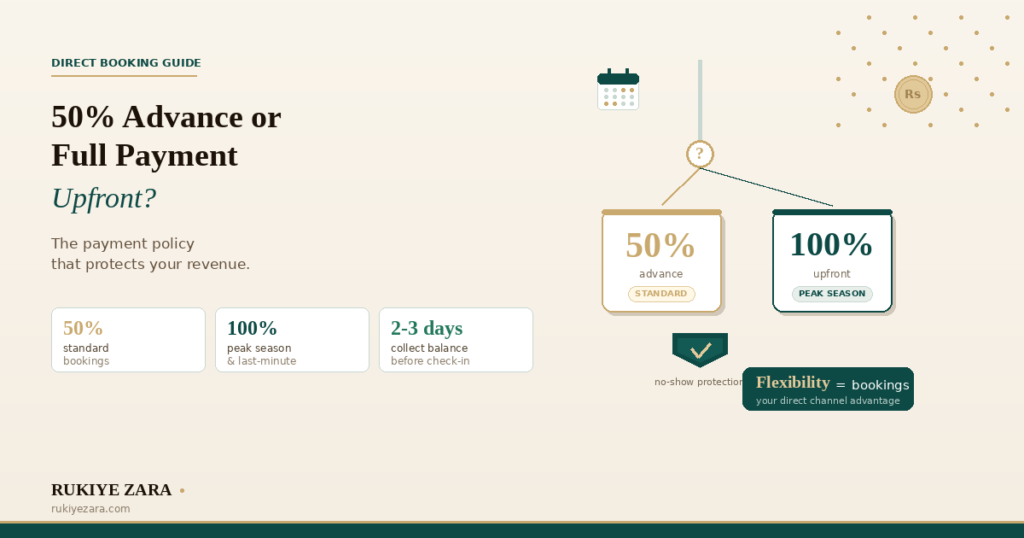
50% at booking, 50% at check-in
- Lower friction — new guests are more comfortable paying half
- Enough commitment to block no-shows
- Feels fair and reasonable to the guest
- Easier to sell as a “direct booking perk”
- Works well for bookings 2+ weeks out
100% at booking
- Zero no-show risk — dates are fully committed
- Better cash flow — money in hand before check-in
- Standard for peak season and long weekends
- Expected for last-minute bookings (under 72 hours)
- Simpler — no follow-up needed for balance
For most standard bookings — a couple booking your homestay two weeks from now, a family planning a holiday next month — 50% advance is the sweet spot. It’s enough money to filter out tyre-kickers and no-shows, but not so much that a first-time direct guest hesitates.
Think about it from the guest’s side. They’ve never stayed with you before. They found you on Instagram or Google, not through a platform with buyer protection. Asking for ₹15,000 upfront for a ₹30,000 stay feels fair. Asking for the full ₹30,000 feels like a risk — what if the place isn’t as shown?
50% advance says: “I trust you enough to hold your dates. You trust me enough to commit.”
When to insist on full payment
There are situations where 50% isn’t enough. Full payment upfront is standard — and expected — in these cases:
Peak-season bookings. Christmas, New Year, Diwali weekends, Holi long weekends — these are dates you can sell exactly once. A no-show on December 30th doesn’t just cost you that booking; it costs you the booking you turned away. Full payment, non-refundable, is the norm here. Guests know this.
Last-minute bookings. If someone books less than 72 hours before check-in, collect the full amount. There’s no time to chase a balance, and last-minute guests are either committed or they’re not coming.
Long stays (7+ nights). For extended bookings, full payment upfront protects you from the guest who checks out early and disputes the balance. Alternatively, you can collect 50% at booking and the remaining 50% three days before check-in (not at check-in — by then it’s too late if they don’t pay).
Guests with no profile or history. If it’s a first-time direct booking from someone you can’t verify through any channel — no mutual connections, no social profile, no OTA review history — full payment is reasonable protection.
The decision matrix
Here’s a simple framework. No need to overthink it:
| Situation | Payment policy | Why |
|---|---|---|
| Standard booking, 2+ weeks out | 50% advance | Low risk, builds trust |
| Repeat guest | 50% advance (or token amount) | Relationship already established |
| Peak season / long weekend | 100% upfront | Dates can’t be resold |
| Booking within 72 hours | 100% upfront | No time to chase balance |
| Long stay (7+ nights) | 50% at booking + 50% three days before | Protects against early checkout |
| Guest referred by someone you know | 50% advance | Social proof lowers risk |
| Unknown guest, no verifiable profile | 100% upfront | No trust signal, protect yourself |
Notice the pattern: the more replaceable the dates, the more flexible you can be. The harder the dates are to resell, the more you should collect upfront.
Your cancellation policy is the other half
A payment policy without a cancellation policy is incomplete. Guests need to know what happens if they cancel — and you need to know this before the situation comes up, not when a guest is on the phone asking for a refund at 11 PM.
Here’s a template that works for most homestays:
14+ days before check-in: Full refund of advance.
7–14 days before check-in: 50% of advance refunded (or full credit toward future dates).
Less than 7 days: Advance is non-refundable. Date change allowed subject to availability.
Peak season / long weekends: Advance is non-refundable from the point of booking. Date change only.
Two things to note. First, offering date changes instead of refunds is a powerful middle ground — the guest doesn’t lose their money, and you don’t lose the revenue. Second, always share these terms before accepting payment. A screenshot of your terms on WhatsApp, or terms displayed on your booking page, protects both sides.
Collecting the balance: don’t leave it to check-in
The biggest mistake hosts make with partial advance: waiting until the guest is at your door to collect the rest. By then, your leverage is gone. The guest is standing in your living room. You’re not going to turn them away over an unpaid balance.
Rule of thumb: Collect the remaining balance 2–3 days before check-in, not at check-in. Send a polite reminder on WhatsApp with a payment link. If the balance isn’t paid 24 hours before arrival, follow up with a call. This gives you time to react if the guest ghosts.
If you’re collecting payments manually — UPI, bank transfer, WhatsApp — this follow-up is on you. Every time. For every booking. It works when you have 2–3 bookings a month. It becomes a headache at 8–10.
A booking website with a payment gateway handles this differently. The guest pays at booking through the website, you get a proper booking record, and there’s no balance to chase. It’s one of those things that doesn’t feel important until you’ve had your third booking where you’re texting someone to pay their remaining ₹12,000 at 10 PM the night before check-in.
What about UPI and bank transfers?
If you’re accepting UPI or direct bank transfers, the payment policy works the same — 50% or 100%, your call. But the process is manual:
You share your UPI ID or QR code. The guest pays. You check your account. You send a confirmation message. You note the booking in your register or spreadsheet. You set a reminder to collect the balance. You follow up. You confirm again.
None of this is hard. All of it takes time. And when you’re managing multiple bookings across multiple channels — OTA guests, direct website guests, WhatsApp inquiries, Instagram DMs — the manual payment tracking is where things start slipping through.
This isn’t an argument against UPI — it’s the most popular payment method in India for a reason. It’s an argument for having a system that tracks your bookings and payments in one place, regardless of how the guest pays.
Use payment flexibility as a booking advantage
Here’s what most hosts miss: flexible payment terms are a competitive advantage over OTAs.
On Airbnb, the guest has exactly one option: pay everything now. On your direct channel, you can offer 50% now, 50% later — and that alone is a reason for price-sensitive guests to book with you. Pair it with the fact that your direct price is already lower (no 15–20% OTA commission built into the rate), and you have a genuinely better deal.
The pitch is simple: “Book direct, pay 50% now — the rest closer to your stay. Same room, better rate, more flexibility.” That’s not a gimmick. That’s a real benefit of owning your booking channel.
But the pitch only works if you have a place to send them. A booking website — even a simple one — makes the direct booking feel as professional as an OTA. Rukiye Zara’s Starter plan gives you a booking website at no monthly cost, so there’s no reason not to have one running alongside your OTA listings.
The bottom line
There’s no single right answer to “50% or 100%?” — the right answer changes with the season, the guest, and the booking window. What matters is having a clear policy, communicating it before taking payment, and having a cancellation framework that protects your revenue without making guests feel trapped.
For most Indian homestays, the default should be 50% advance for standard bookings and 100% for peak season and last-minute. Keep it simple, be upfront about it, and use the flexibility as a reason for guests to book with you directly.
Set up your direct booking channel
A booking website with a payment gateway handles advances, confirmations, and booking records — so you don’t have to chase every payment on WhatsApp.
Launch your website — freeFrequently asked questions
What percentage advance should I take for homestay bookings?
Most successful homestay hosts collect 50% at booking and 50% at check-in for standard reservations. For peak-season bookings, long weekends, and last-minute reservations (less than 72 hours away), collecting 100% upfront is standard practice and guests expect it.
How do I handle cancellations when I’ve taken only 50% advance?
Set a clear cancellation window — typically 7–14 days before check-in for a full refund of the advance, and non-refundable within 7 days. For peak-season bookings, make the advance non-refundable from the start or allow only date changes. Always share your cancellation terms in writing before accepting payment.
Should I take full payment upfront for all direct bookings?
Not necessarily. Full payment upfront reduces your no-show risk to zero but also creates more booking friction, especially for new guests who haven’t stayed with you before. A 50% advance strikes the right balance for most bookings — it shows guest commitment while keeping the booking process smooth.
Is it safe to accept UPI or bank transfer for advance payments?
UPI and bank transfers are safe for payment collection, but they create manual work — you need to track who paid, match amounts, send confirmations, and follow up for the balance. A booking website with a built-in payment gateway automates all of this and gives you a proper booking record for each reservation.
What if a guest refuses to pay any advance?
A guest who refuses to pay any advance is a no-show risk. Politely explain that an advance confirms the booking and blocks the dates for them. If they still refuse, it’s usually better to keep your dates open for a committed guest. The only exception might be a repeat guest you trust — and even then, a token advance protects both sides.
Should my payment policy be different on OTAs vs. direct bookings?
On OTAs, the platform handles payment — you don’t choose the terms. For direct bookings, you set the rules. This is actually an advantage: you can offer flexible payment (50% now, 50% later) as a reason for guests to book direct, while still requiring full payment for peak dates. Your direct booking channel gives you this control.