


Is 2026 a good time to start?
Yes — but not for the reasons most “start a homestay” guides will tell you. The domestic travel boom is real. India’s short-term rental market has grown steadily since 2021, driven by remote work, weekend travel from metros, and a generational shift toward unique stays over standard hotels. The demand is there.
What’s changed is the supply side. There are more homestays than ever. Airbnb listings in popular Indian destinations have tripled in five years. Standing out on an OTA platform is harder and more expensive than it used to be. And the commission structure means that as competition drives rates down, the platform takes the same percentage from a shrinking margin.
The hosts who do well in 2026 are the ones who treat their homestay as a small business from the start — with their own brand, their own booking channel, and their own guest relationships — rather than a listing on someone else’s platform.
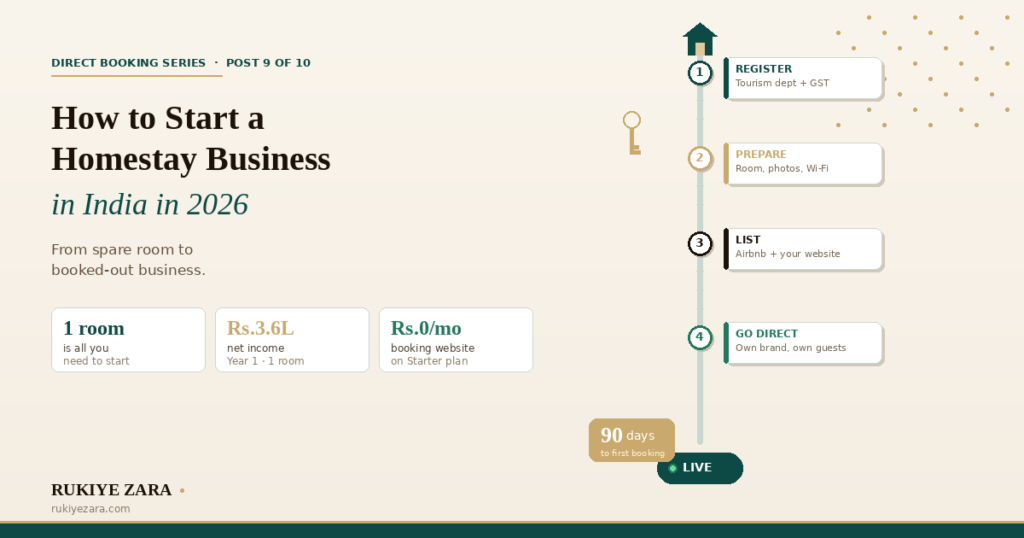
Step 1: Legal and registration basics
Before you book your first guest, sort out the paperwork. The exact requirements vary by state, but here’s the baseline across India:
- State tourism registration — Most states require homestays to register with the tourism department. Kerala, Himachal Pradesh, Karnataka, Uttarakhand, Rajasthan, and Goa all have formal homestay policies. Check your state’s tourism website for the application form and process.
- Local municipal permissions — Some municipalities or panchayats require a trade licence or local permission to operate a homestay. Check with your local body.
- Fire and safety compliance — Required in most states, especially if you have more than 2–3 rooms. Basic fire extinguishers and emergency exit signage are standard.
- GST registration — Required if your annual turnover exceeds ₹20 lakh (₹10 lakh for special category states). Even below this, voluntary registration lets you claim input tax credits on purchases and renovations.
- FSSAI licence — Required if you serve food to guests (even breakfast). The basic registration is straightforward for small operations.
- Foreign guest registration — If you host international guests, you need to report their stay on the C-Form (FRRO portal) within 24 hours of check-in.
Don’t let the paperwork stop you — most of these registrations are one-time processes that take a few weeks. The penalty for operating without registration varies by state but can include fines and closure orders, so get it done before you start hosting.
Step 2: Prepare your space
You don’t need a heritage haveli or a cliffside villa. You need a clean, well-maintained private room or unit with its own bathroom, reliable Wi-Fi, and a host who cares. Most successful homestays in India start with a spare room in the host’s own home.
Clean, private bathroom — Shared bathrooms are a dealbreaker for most travellers. If you can’t offer an attached bath, invest in adding one before you list.
Reliable Wi-Fi — Remote workers and digital nomads are a large segment of the homestay market. If your area has connectivity issues, invest in a good router and a backup connection.
Fresh linen and towels — Hotel-quality white linen signals professionalism. Replace it often; guests notice worn sheets.
Hot water — Year-round, not seasonal. A geyser or solar heater is a basic expectation.
Good lighting — Warm, well-placed lighting makes a room feel twice as expensive. Avoid harsh fluorescent tubes.
Lockable room — Guests need to feel their belongings are secure.
Beyond the basics, focus on one or two things that make your place memorable. Maybe it’s a balcony with a mountain view, a home-cooked breakfast, a garden where guests can sit with coffee, or your knowledge of local trails and hidden restaurants. The “experience” isn’t a marketing buzzword — it’s the reason someone books a homestay instead of a hotel.
Step 3: Set your pricing
Pricing a new homestay is the most common source of anxiety for first-time hosts. You don’t have reviews yet, you don’t know what guests will pay, and you don’t want to price yourself out of the market or leave money on the table.
Here’s a practical framework:
Research your local market
Search Airbnb and Google Maps for homestays within 5–10 km of your property. Note their rates, room types, and what they include (breakfast, parking, etc.). You’ll see a range — focus on the middle, not the cheapest.
Start 10–15% below your target rate
As a new listing with no reviews, you need to earn trust. Starting slightly below your target rate gets your first 5–10 bookings faster. Once you have reviews, raise your rate to where it belongs. This is a launch strategy, not a permanent discount.
Include breakfast in your rate
A homemade breakfast is your strongest differentiator over hotels and other homestays. Including it in your nightly rate simplifies the guest’s decision and lets you charge more overall. A breakfast that costs you ₹150–200 per guest can support a ₹500–1,000 premium on your rate.
Price differently for weekends and seasons
Weekend rates (Friday–Sunday) can be 20–30% higher than weekday rates in leisure destinations. Peak season rates should be 30–50% above your base rate. Off-season rates should drop 15–20% — enough to attract bookings without devaluing your property.
Step 4: List on Airbnb — but don’t stop there
Airbnb is where most new homestays get their first bookings, and there’s nothing wrong with that. The platform gives you instant visibility, a trusted payment system, and a review mechanism that builds your credibility. List on Airbnb, take it seriously, and focus on getting your first 10 five-star reviews.
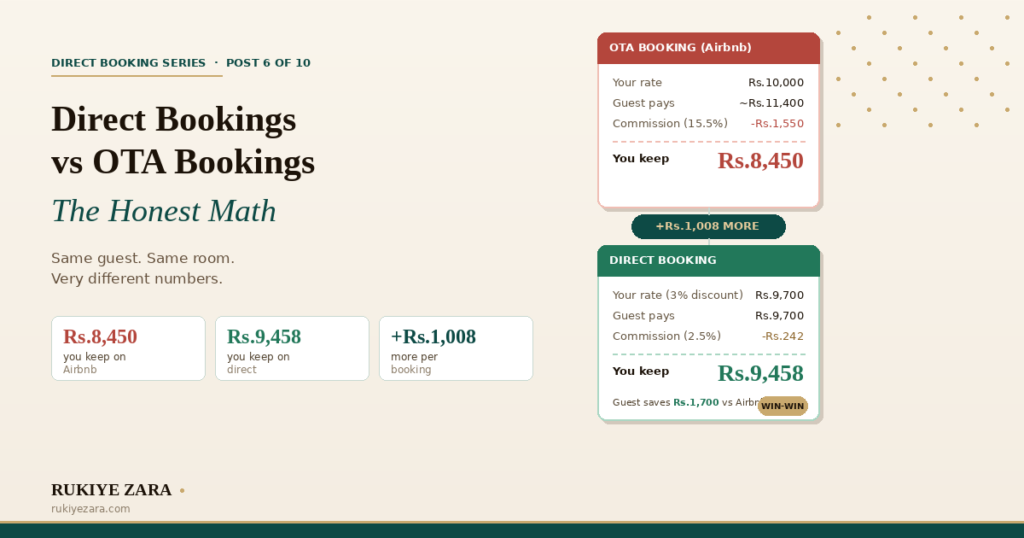
But understand what you’re signing up for. Airbnb takes approximately 15.5% of every booking in India (3% host commission + 12–14% guest service fee that inflates your visible rate). On a ₹5,000/night room, the guest pays around ₹5,700, and you keep about ₹4,225. That’s the cost of discovery — fair for a new property with no reputation.
The mistake most new hosts make is stopping there. They get comfortable with Airbnb bookings and never build their own booking channel. Two years later, they’re paying the same 15.5% on repeat guests who would happily book directly if given the option.
Step 5: Set up your own booking website from day one
This is the step most guides skip — and it’s the one that separates hobby hosts from business owners.
Setting up a booking website on day one doesn’t mean you’ll get direct bookings on day one. It means that when your first Airbnb guest checks out and says “I’ll definitely come back,” you have a link to give them. When a friend asks for your recommendation, you have a professional page to share. When someone finds you on Instagram, they can book without messaging you and waiting for a reply.
Your booking website should have:
- Your rooms with photos, descriptions, and rates
- Live availability calendar
- Online booking with instant confirmation
- Your property’s story — who you are, where you’re located, what makes it special
- Your WhatsApp number for guests who want to chat first
The Starter plan is free — no monthly fee, just 2.5% commission on bookings that come through your site. There’s no reason not to set it up while you’re setting up everything else.
Step 6: Get your first reviews
Reviews are the currency of trust in the homestay business. Your first 10 reviews matter more than your next 100. Here’s how to earn them fast:
Over-deliver on the basics. A spotless room, a warm welcome, a better-than-expected breakfast. Guests review what surprised them — make sure the surprises are positive.
Be present without being intrusive. Check in briefly after arrival: “Everything okay with the room? Here’s my number if you need anything.” Then let them be. The best homestay hosts are available without hovering.
Ask for the review at the right moment. Not during checkout (too rushed) and not three days later (they’ve moved on). The sweet spot is a WhatsApp message the evening after checkout: “Hope you had a great stay! If you have a moment, a review would really help us — we’re just getting started.”
Respond to every review. Even five-star ones. A thoughtful response shows future guests that you read feedback and care about the experience.
The money: what to realistically expect
Let’s do honest math for a single-room homestay in a popular leisure destination.
That’s ₹30,000/month from a single room — before you start shifting bookings to your direct channel (where you’d keep ₹55,000–₹85,000 more per year in saved commission). With two rooms, the numbers roughly double, while operating costs increase by less than 2x because many costs are shared.
This is conservative. Some homestays in high-demand locations (Goa beaches, Himachal hills, Kerala backwaters) achieve 80%+ annual occupancy and charge ₹5,000–₹10,000/night. But planning around conservative numbers means you won’t be disappointed and every upside surprise is genuinely exciting.
Common mistakes first-time hosts make
Pricing too low to “fill the calendar”: An occupied room at ₹1,500/night costs you almost as much in effort and expenses as one at ₹3,500. Price for value, not for occupancy percentage. Empty nights at the right rate are better than full nights at a loss.
Ignoring off-season entirely: Off-season is when your guest database earns its keep. A WhatsApp broadcast to past guests with monsoon rates fills 20–30% of those empty dates.
No photos, or phone-camera photos: Your listing photos are your first impression. Hire a photographer for half a day — ₹3,000–₹5,000 for professional photos that increase your booking rate for years.
No online presence beyond Airbnb: Instagram, Google Maps listing, your own booking website — each one is a channel that brings guests who’d never find you on Airbnb alone. Start these early, even before you have bookings.
Not collecting guest contacts: Every guest who books through Airbnb is a guest whose phone number and email Airbnb keeps, not you. Direct bookings — even a few — give you a database you can reach for repeat bookings, referrals, and off-season outreach.
Your first 90 days: a roadmap
Week 1–2: Legal and registration
Apply for state tourism registration. Check local municipal requirements. If you’ll serve food, start the FSSAI registration. Get fire safety basics (extinguisher, signage) in place.
Week 2–3: Prepare and photograph your space
Deep clean and stage the room. Fix anything that’s been “fine for now” — leaky taps, dim lights, chipped paint. Hire a photographer. Take photos during golden hour for warm, inviting images.
Week 3–4: Set up your online presence
List on Airbnb with professional photos and a well-written description. Set up your booking website. Create a Google Maps listing. Set up an Instagram page with 9–12 posts showing your space, your location, and your breakfast.
Month 2–3: First guests and first reviews
Price 10–15% below target to attract first bookings. Over-deliver on every stay. Ask for reviews at the right moment. Share your booking website link at checkout. Within 90 days, aim for 8–10 reviews and at least one guest who’s bookmarked your direct booking link.
Start with the end in mind
Most guides tell you to start on Airbnb and figure out the rest later. That works — but “later” often becomes “never.” The hosts who build sustainable businesses are the ones who set up their direct booking channel alongside their OTA listing, not after it.
The Starter plan is free. Set up your booking website the same week you list on Airbnb. Share it with every guest who checks out. Within a year, you’ll have a guest database, a growing direct booking channel, and a business that doesn’t depend entirely on one platform’s algorithm.
That’s not just a better way to start — it’s a better way to run a homestay.
Ready to launch your homestay?
Set up your booking website alongside your first listing. Free to start, and your first direct booking will pay for itself.
Launch your booking website →Frequently asked questions
How much does it cost to start a homestay in India?
Do I need to quit my job to run a homestay?
Should I list on Booking.com as well as Airbnb?
What’s the best location for a homestay in India?
How many rooms do I need to start?
Why should I set up a booking website before I even have reviews?
- Guest wants to pay on UPI/WhatsApp — should you accept?
- A guest from last year wants the same rate — should you give it?
- Airbnb suspended my listing — now what?
- My Airbnb isn’t making money anymore — what changed?
- How to increase Airbnb bookings in 2026
- Direct bookings vs. OTA bookings — the honest math
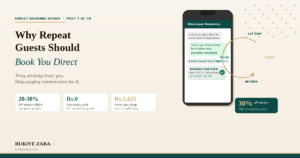
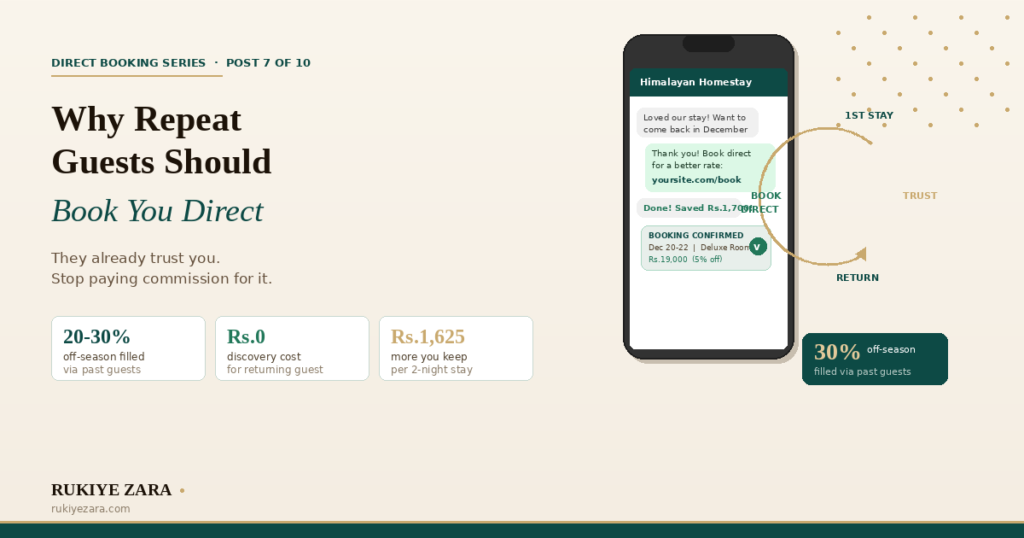
- Why repeat guests should book you direct
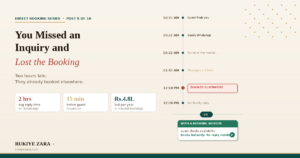
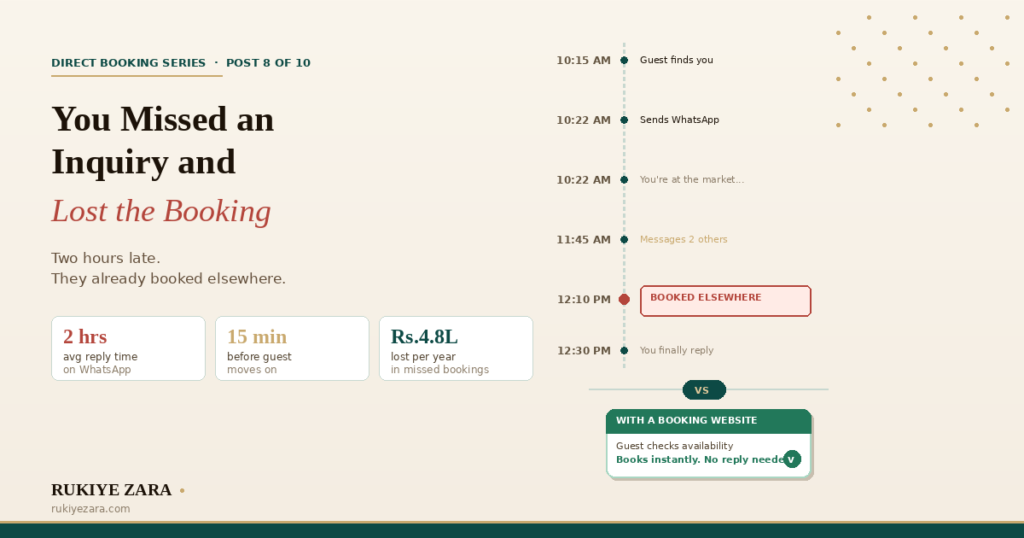
- You missed an inquiry and lost the booking
- How to start a homestay business in India in 2026 (You are here)
- Can you quit your 9–5 and live off homestay income?
Also read: How to get direct bookings for your homestay · A direct booking website for your homestay