


The fantasy vs. the math
There’s a version of the homestay dream that’s all over social media: wake up to mountain views, chat with interesting travellers, earn passive income from your ancestral property. No boss, no commute, no meetings.
The reality is more interesting than the fantasy, but also more specific. You can absolutely earn a full-time income from hosting. Many people in India do — from Coorg to Kasol to Goa. But the ones who sustain it for years (not just one good season) have something in common: they ran the numbers before they quit, and they built systems before the bookings overwhelmed them.
Let’s run those numbers.
How much do you actually need to replace?
Before asking “can a homestay pay my bills?” — figure out what your bills actually are. Most people overestimate what they need from the homestay, because they’re comparing it to a metro salary without adjusting for the lifestyle change.
A ₹12 lakh/year salary in Gurgaon often means ₹8–9 lakh in actual take-home after taxes, PF, and insurance. That covers ₹25,000–₹35,000/month rent, ₹8,000–₹12,000 commute costs, ₹15,000+ in eating out and convenience spending that comes with a demanding job.
Running a homestay from your own property in a smaller town or village eliminates most of these. No rent (you live where you host), no commute, lower food costs. Your actual monthly need might be ₹40,000–₹60,000 — not ₹80,000.
That changes the target from “match my salary” to “can 2–3 rooms earn ₹50,000/month consistently?”
The real numbers: 2 rooms, 3 rooms, 5 rooms
Here’s the math at three scales, using conservative estimates for a leisure destination (hill station, beach town, or heritage area) with seasonal demand. Rates and occupancy are based on what hosts in these markets actually report — not peak-season best-case scenarios.
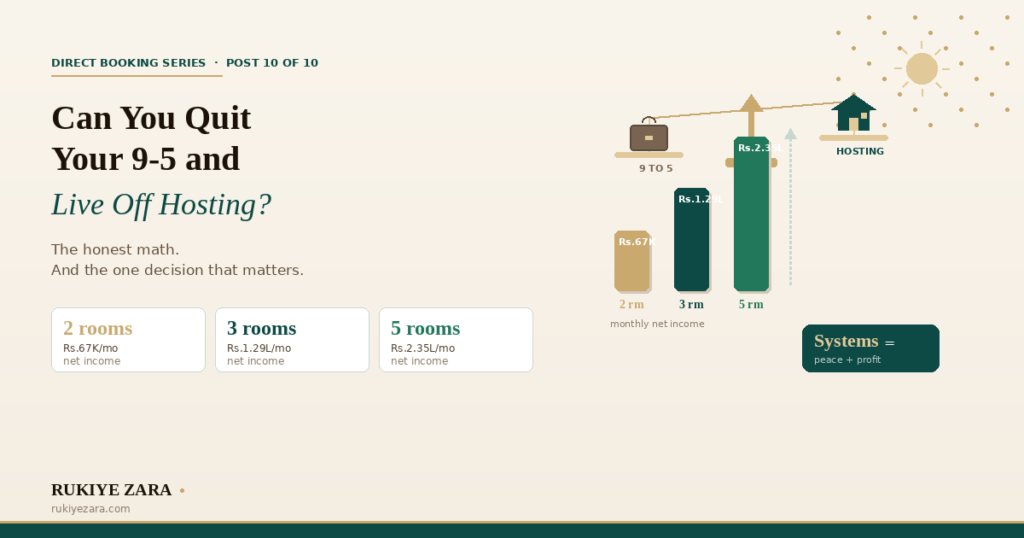
That’s ₹67,000/month — enough for a comfortable life in most tier-2 and tier-3 locations, and more than enough if you own your property outright. It’s tight for a family in a metro, but for someone moving to their property in a smaller town, this is a solid income.
₹1,29,000/month. At this point you’re not just replacing a salary — you’re building a business that can compound. Three rooms at 50% occupancy means 4–5 bookings running simultaneously in peak season. You need help with cleaning. You need a system for managing reservations. You need to stop being the only person who answers the phone.
₹2,35,000/month. This is the point where hosting stops being a lifestyle choice and starts being a serious business. Five rooms across multiple platforms, dozens of bookings per month, staff to manage, reviews to respond to, pricing to adjust. Without systems, this scale is exhausting. With them, it’s surprisingly calm.
The inflection point nobody warns you about
Here’s what the “quit your job and host” content doesn’t tell you: the transition from 1–2 rooms to 3–5 rooms is where most hosts either burn out or level up. And the difference is almost never about the property or the location — it’s about systems.
Host without systems
- Manually checks Airbnb, Booking.com, and WhatsApp for new bookings
- Updates calendar on each platform by hand — double bookings happen
- Responds to every inquiry personally, even at 11 PM
- Doesn’t know their actual occupancy rate or revenue until they count manually
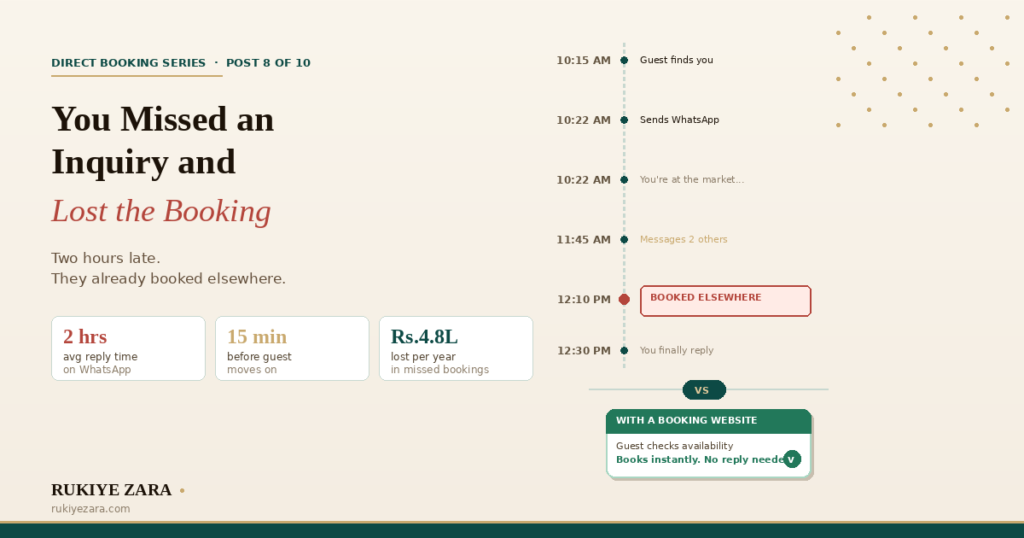
- Loses bookings when they’re at the market or on a day off
- Can never fully disconnect — “what if a guest messages?”
Host with systems
- Booking website handles inquiries and takes reservations 24/7
- Channel manager syncs availability across all platforms automatically
- Guests see live rates and availability — book without waiting for a reply
- Dashboard shows occupancy, revenue, and upcoming check-ins at a glance
- WhatsApp auto-reply shares booking link — no booking lost to slow replies
- Can take a day off without anxiety
The system doesn’t need to be expensive. It needs to exist before you need it. The hosts who set up a booking website, a channel manager, and a dashboard before they’re overwhelmed are the ones who actually enjoy hosting at 3–5 rooms. The ones who wait until they’re drowning in WhatsApp messages and manually copying rates between platforms are the ones who consider going back to the 9–5.
The system that costs less than one lost booking
A booking website on the Starter plan is free — ₹0/month, 2.5% commission only on bookings that come through your site. When you expand to 3+ rooms and need a channel manager to sync your availability across Airbnb, Booking.com, and your website, the Growth plan is ₹999/month — less than a single night’s revenue. And from Pro, the commission on your booking engine drops to zero.
The cost of not having systems is higher: missed inquiries, double bookings, burned-out hosts who can’t take a day off. Peace of mind doesn’t cost much. Not having it costs a lot.
When should you actually quit?
Not when your homestay has one good month. Not when peak season fills your calendar. Here are the real signals that you’re ready:
Your property earns consistently for 6+ months
Not just during Diwali and Christmas. You need to see what your property earns in July, August, and September before you bet your livelihood on it. Track your actual revenue and expenses, month by month, for at least two full seasons.
You have 6 months of living expenses saved
A homestay income is variable. Some months will be ₹80,000; others will be ₹25,000. A cash buffer means you don’t panic-discount during the lean months, which protects your long-term pricing.
Your direct booking channel is working
If 100% of your bookings come from Airbnb, you’re one algorithm change away from a bad quarter. Having even 20–30% of bookings coming through your own website means you have a channel you control — with better margins and guests you can reach directly for repeat stays.
Your systems can run without you for 48 hours
Take a weekend completely offline. No checking messages, no updating calendars, no responding to inquiries. If your property still takes bookings and nothing catches fire, you have a business. If everything collapses in 48 hours, you have a job — and a more stressful one than the one you left.
The expansion question: when to add rooms
Once your first 2 rooms are running at 50%+ occupancy with good reviews, the urge to add rooms is natural. And it’s usually the right move — more rooms mean more revenue without proportionally more work, because the fixed costs (your time, your property’s location advantage, your online presence) are already covered.
But expansion is also the moment where “doing everything myself” stops working. With 1–2 rooms, you can manage bookings in your head, update calendars manually, and respond to every message personally. With 3–5 rooms, that approach breaks. You get double bookings. You miss inquiries. You spend your mornings updating three different platforms instead of having breakfast with your guests.
This is where a small investment in systems pays for itself many times over. Not in expensive enterprise software — in a simple setup that handles the operational busywork so you can focus on what actually matters: the guest experience, the property, and enjoying the life you built this for.
Your own booking website — so guests can check availability and book without messaging you. This handles inquiries 24/7, including the ones that come in while you’re at the market.
A channel manager — so your rates and availability sync automatically across Airbnb, Booking.com, and your website. No more manually blocking dates on three platforms. No more double bookings.
A dashboard — so you know your occupancy, revenue, and upcoming check-ins at a glance, instead of counting bookings in your head.
That’s it. Not a dozen tools. Not a ₹50,000/year software stack. One system that does the three things that consume 80% of a host’s operational time. The rest of hosting — welcoming guests, maintaining the property, building your reputation — is yours to enjoy.
The real lifestyle: what full-time hosting actually looks like
After the first year, the daily routine of a full-time host is surprisingly calm — if your systems are in place. Here’s what a typical week looks like with 3 rooms and decent occupancy:
Morning: Check your dashboard for today’s check-ins and check-outs. Coordinate cleaning. Greet arriving guests. This takes 1–2 hours.
Midday: Your time. Errands, property maintenance, a walk, a long lunch. Bookings come in through your website. You get a notification, not an interruption.
Evening: A quick check on messages. Respond to any guest requests. Update anything that needs updating. Maybe 30–45 minutes.
Off-season: This is where the lifestyle really shines. With a guest database from your direct bookings, you can send a WhatsApp broadcast to past guests with monsoon or off-season rates. This fills 20–30% of otherwise empty dates without you spending anything on marketing. The rest of your time is yours — renovations, travel, planning the next room, or simply doing nothing.
The key phrase in all of this: “if your systems are in place.” Without them, every paragraph above includes “…while also checking Airbnb, responding to three WhatsApp messages, and updating the calendar on Booking.com before you forget.” With them, you’re a host. Without them, you’re a receptionist who also owns the building.
What about health insurance, retirement, and stability?
These are the real concerns that the “quit your job” influencers gloss over. Let’s address them directly.
Health insurance: You’ll need to buy your own. Good individual health insurance in India costs ₹15,000–₹30,000/year for a comprehensive plan. Factor this into your expenses. This is non-negotiable.
Retirement savings: No PF contributions from an employer. Set up a systematic investment plan (SIP) of 10–15% of your monthly income. Discipline matters here — there’s no payroll deducting it automatically.
Income variability: Your best month might earn 3x your worst month. Build your budget around 70% of your average monthly income, not 100%. The buffer handles the lean months without stress.
Platform risk: If all your income comes from one OTA, you’re exposed to their policy changes, commission increases, and algorithm shifts. Having your own booking website and a direct booking channel is insurance — it means you always have a way to reach guests, regardless of what any platform does.
The honest answer
Can you quit your 9–5 and live off homestay income? Yes — with two rooms and decent occupancy, you can match the take-home of many salaried positions in India, especially if you’re hosting from your own property in a tier-2 or tier-3 location.
Should you? That depends on what you’re optimizing for. If it’s maximum income, a tech job in Bangalore will probably pay more than a 3-room homestay in Nainital. If it’s autonomy, location independence, a slower pace, and the satisfaction of building something that’s yours — hosting can give you a life that no salary matches.
The hosts who thrive long-term are the ones who treat it like a business from the start: they run the numbers, they set up systems early, and they build a direct booking channel so their business doesn’t depend entirely on platforms they don’t control. They don’t wait until they’re overwhelmed to get organized — they start organized and stay that way as they grow.
Start with the system, not the stress
Whether you’re hosting part-time or ready to go full-time, set up the system that lets you enjoy it. Free to start.
Launch your booking website →Frequently asked questions
How many rooms do I need to replace a salaried income?
Should I quit my job before starting a homestay?
What’s the biggest risk of full-time hosting?
How do I handle off-season income dips?
When should I invest in a channel manager?
Can I run a homestay from a rented property?
- Guest wants to pay on UPI/WhatsApp — should you accept?
- A guest from last year wants the same rate — should you give it?
- Airbnb suspended my listing — now what?
- My Airbnb isn’t making money anymore — what changed?
- How to increase Airbnb bookings in 2026
- Direct bookings vs. OTA bookings — the honest math
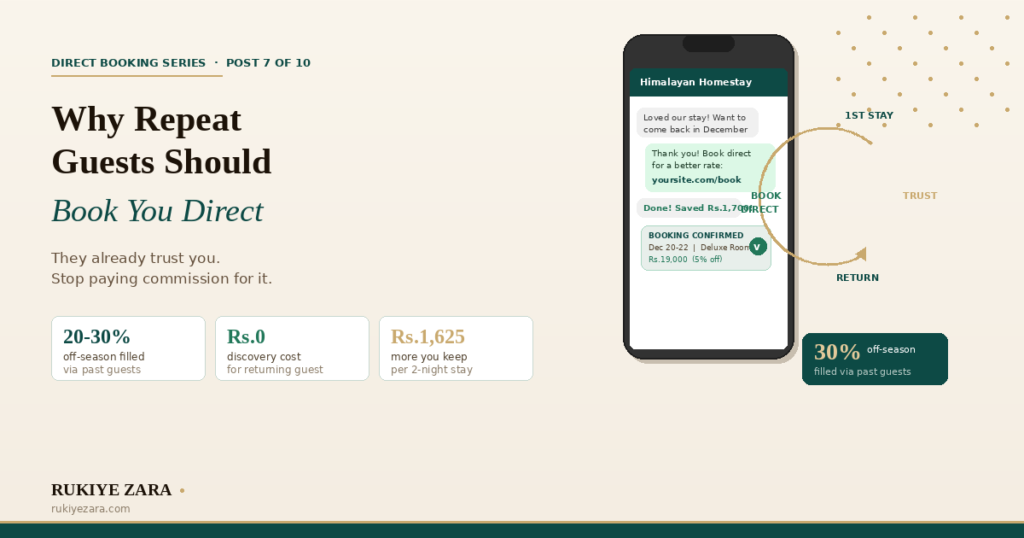
- Why repeat guests should book you direct
- You missed an inquiry and lost the booking
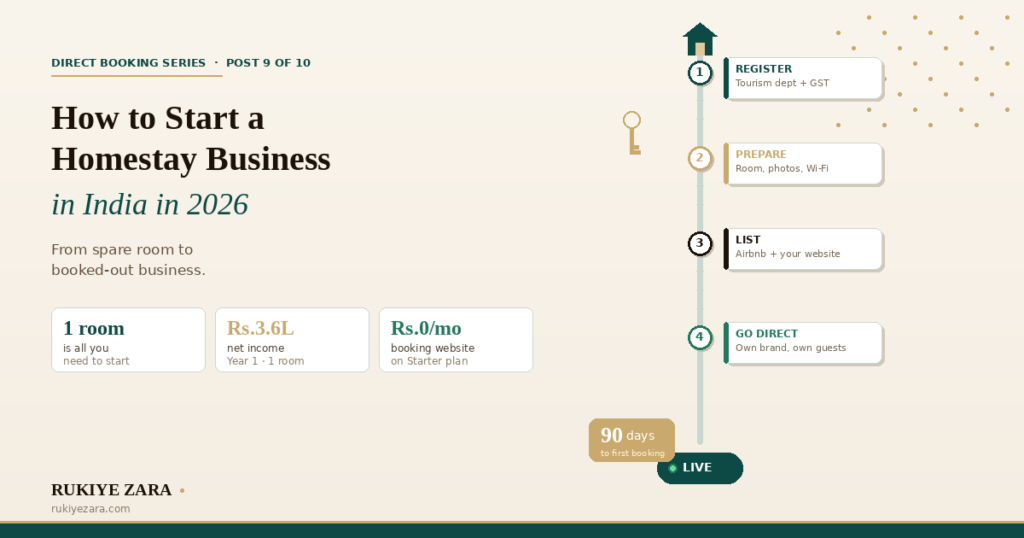
- How to start a homestay business in India in 2026
- Can you quit your 9–5 and live off homestay income? (You are here)
Also read: How to get direct bookings for your homestay · A direct booking website for your homestay · What OTAs really cost your homestay